Physical Address
304 North Cardinal St.
Dorchester Center, MA 02124
Physical Address
304 North Cardinal St.
Dorchester Center, MA 02124
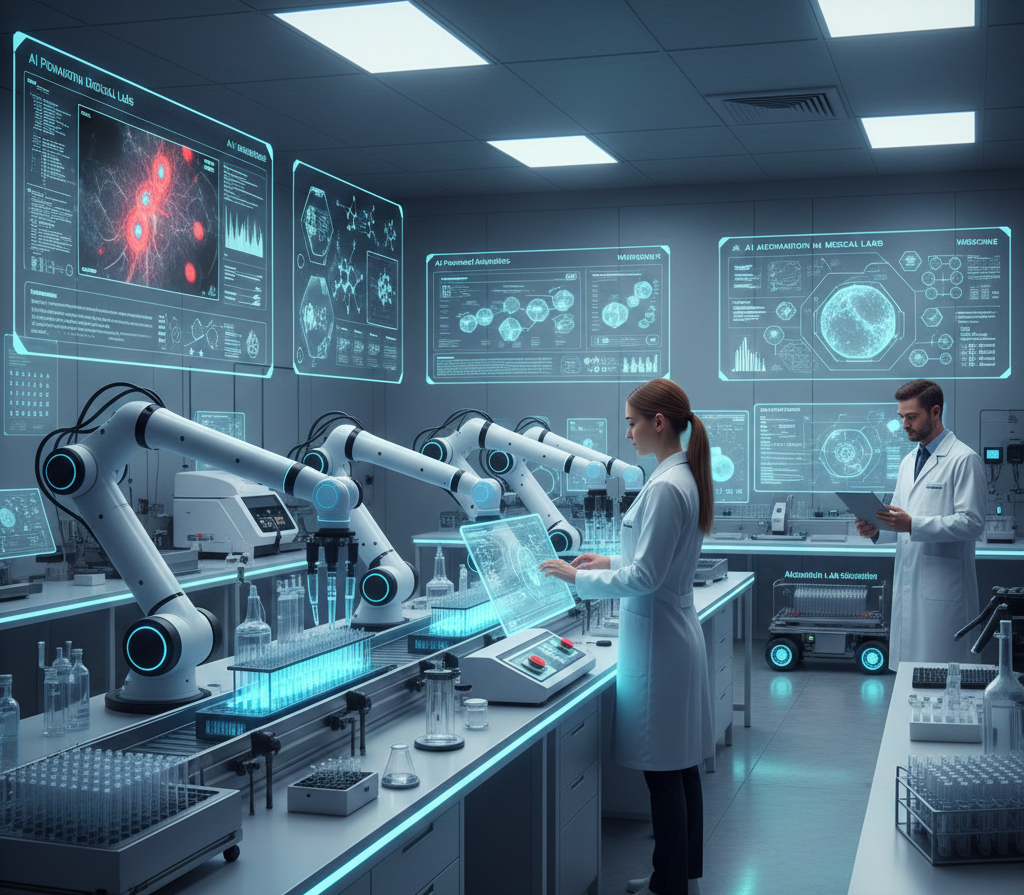
The medical laboratory is the engine room for healthcare. It provides over 70% of data for medical decision-making in medicine. The traditional medical laboratory used pipettes requiring human assistance. It involved careful staining and the observation skills of a medical lab scientist. Those are bygone days. “AI Automation is no longer a future vision but today’s word for excellence.”
The application of AI Automation in medical lab technology changes patient care. It impacts everything from high-throughput molecular diagnostics to predictive analytics.
The “smart lab” began with simple mechanical automation. Companion machines executed repetitive actions like “centrifuging and chemistry panels.” Today’s AI Automation mimics human brain functions.
As in 2025, “hardware robotics and software intelligence work in symbiosis.” This makes laboratory workflow invisible to users and patient care. Medical lab technology today involves:
Pre-analytic Automation: “Sample sorting and labeling by robots with a reduced potential for error in laboratory error accounts for 60 to 70% laboratory error.”
Analytic Intelligence: “Machine learning by computers for genomic or digital pathology applications.”
Post-Analytic Intelligence: “All critical alerts are immediately set by software even prompting next steps for patient follow-through as built from patient history.”
Precision automation in medicine traditionally referred to “doing,” while Artificial Intelligence means “thinking.” In medical research, “disease diagnostics by computers are ‘bridging gaps between raw information and practical knowledge.’”
In hematology, microbiology, and pathology, AI Automation radically changes the identification of bacteria, parasites, or cancer cells. For instance, AI-driven digital slide scanners analyze thousands of blood samples per second. These scanners single out elusive parasites that may escape the scrutiny of a medical lab scientist during an eight-hour shift.
Today, AI technology is being developed to forecast disease outbreaks or patient deterioration before symptoms are detected. Minute variations in laboratory test values—such as fractional changes in creatinine or white blood cell counts—allow medical lab technology to give early indications of impending sepsis or acute kidney problems.
Since “manual labor” is being taken over by machines, the role of the scientist is moving towards being a “Data Pilot” and “Quality Guardian.”
The new role of the medical lab scientist entails:
Algorithm Validation: Verifying that the models used are reliable, impartial, and pertinent to their population.
Solve Complex Problems: Dealing with the “exception” samples that have been marked as unusual by the AI system.
Systems Management: Monitoring the confluence of the Internet of Medical Things (IoMT) when different laboratory equipment interact through cloud connectivity.
| Feature | Traditional Role | AI-Augmented Role |
| Chief Task | Handling samples manually | Management of automated processes |
| Data Manipulation | Entering data manually and calculating it | Validation of AI output |
| Area of Focus | Procedural tasks | Interpretation and correlation with clinician’s assessment |
| Major Skill | Technical know-how | Data analysis and systems problem-solving |
The main beneficiary of AI Automation in the field of medical lab technology is the patient. The benefit outcomes are:
Turnaround Time Reduced: What took days, like the detection of a particular bacteria and its sensitivity to antibiotics, can now be accomplished in merely hours through AI Automation in molecular medicine.
Increased Patient Safety: By reducing manual interaction, the danger of the medical lab scientist getting harmed through needle stick injuries and samples getting contaminated is abated.
Personalized Medicine: AI can collate laboratory results and genetic data so that the attending physician can prescribe the correct amount of medicine based on how the body is expected to react to it.
The way is paved towards an automated laboratory, and then some difficulties also arise.
“The Black Box” Issue: The used AI algorithms, being complex, present challenges in explaining how an AI system arrived at a certain decision. This is necessary in the field of medicine because of potential litigation and ethical issues.
Area of Data Privacy: Laboratories now supply enormous amounts of data, exposing it to risk of invasion and attacks.
High Investment and Expenses: The only problem is the preliminary cost associated with medical lab technology, and AI Automation can be expensive in the short term.
And looking back at the end of the decade, we can envision AI Automation progressing further into the “Point of Care.” Imagine a handheld analyzer capable of a full metabolic panel, using AI for a diagnostic impression right at the bedside, remotely interpreted by a medical lab scientist from a centralized command center.
Further, the implementation of Large Language Models will allow scientists to “speak” to their data. The scientist could say, “Display all the patients from the previous 24 hours with a rising troponin who have a history of diabetes,” and the scientist would instantly get a graphic display.
The merging of AI Automation with medical lab technology represents the greatest leap in medical sciences since the development of the microscope. It is no substitute for human intelligence, merely an amplifier. The medical lab scientist, however, remains the linchpin of the laboratory, now equipped with technology that will allow them to “see” farther and more clearly than ever before. As medicine progresses into the future, the “smart” laboratory will be the key ingredient for a healthier, more efficient world.