Physical Address
304 North Cardinal St.
Dorchester Center, MA 02124
Physical Address
304 North Cardinal St.
Dorchester Center, MA 02124
Pharmacology has advanced from being the science of discovering drugs and their administration. At present, pharmacology has become an analytical discipline whereby “the diagnostic laboratory is an integral and essential part of the process whereby an internist attempts to make a biochemical assessment.“
For medication to be both safe and effective, the internist must utilize information from biochemical and microbiological testing. The integral link between pharmacology and the lab is most aptly observed in Therapeutic Drug Monitoring (TDM), prior treatment testing, and the stringent use of antibiotic sensitivity. This guide elucidates how medication must be tailored according to the special requirements for the welfare and actual biological needs of each patient.
In the pharmacological approach on medication administration, the “one-size-all approach is dangerous.” This is particularly the case for drugs with a “narrow therapeutic index,” where the “margin between the dose needed for efficacy and the dose leading to adverse effects is very small.“
Therapeutic Drug Monitoring is specifically necessary for drugs where:
The patient’s sensitivity level is irregular and beyond prediction.
The medication has an exceptionally “narrow therapeutic window.“
The patient “sensitivity level is indistinguishable from the disease being treated.“
| Classification | Examples | Why the Drug Should be Monitored |
| Anticonvulsants | Phenytoin, Valproic Acid | Prevent seizures with minimal neurotoxic effects. |
| Antibiotics | Vancomycin, Gentamicin | Prevent nephrotoxicity and ototoxicity. |
| Cardiovascular | Digoxin | Prevent life-threatening “Arrhythmias” associated with the drug. |
| Mood Stabilizers | Lithium | Prevent “Tremors” or “Kidney Failure.” |
| Immunosuppressives | Cyclosporine, Tacrolimus | Prevent “Infection” due to the drug. |
In pharmacological administration, timing is the essence for medication effectiveness.
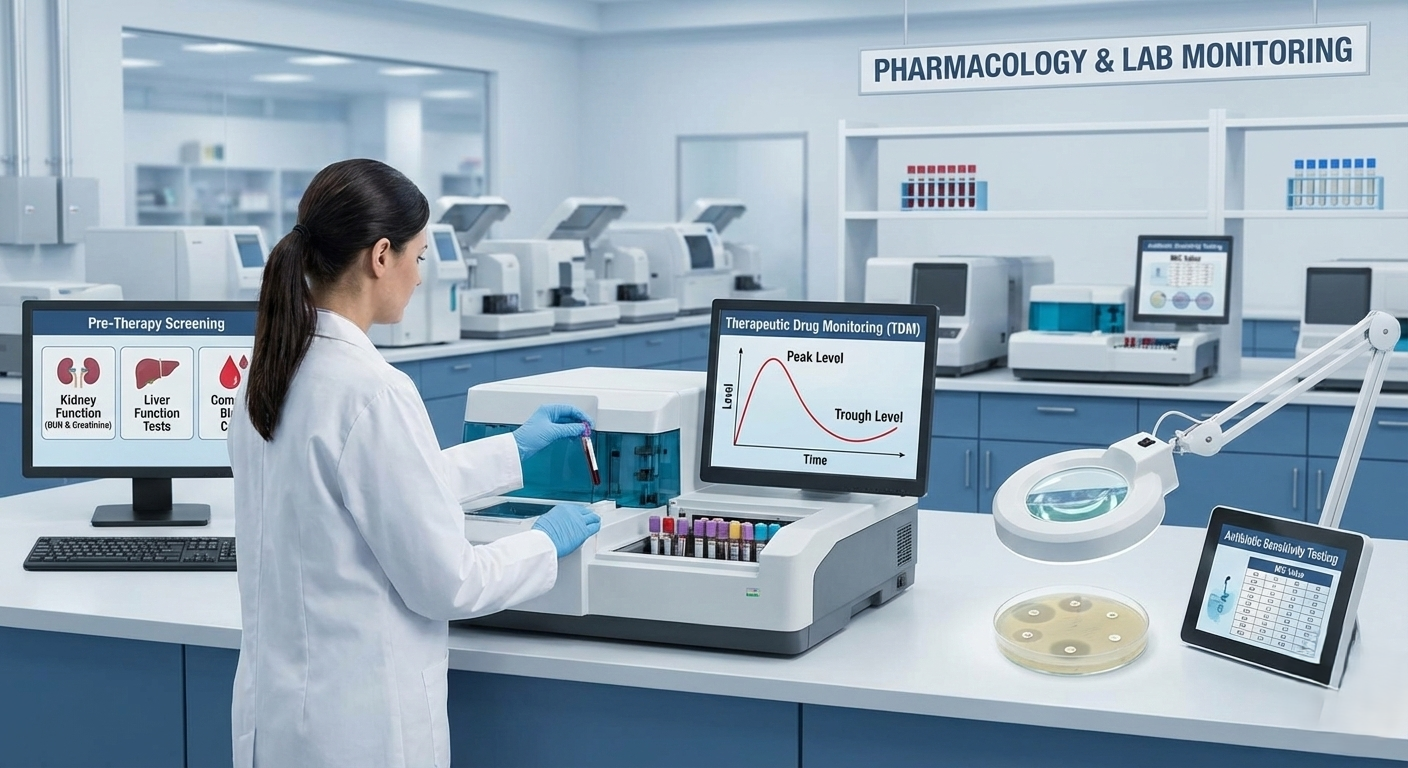
Trough Level: Measurement “just prior to the next dose.” This corresponds with the “lowest level for the particular drug within the patient’s system.“
Peak Level: Measurement “shortly following the administration” (e.g., thirty to sixty minutes following IV administration). This indicates the maximum concentration.
Before prescribing medication, it is essential to consider the patient’s initial level of “clearance.” The Liver and Kidneys play pivotal roles in the pharmacokinetics (or movements of drugs within the system).
Kidney Function (BUN & Creatinine): For drugs eliminated through kidneys (such as Metformin & Lisinopril), lower GFR levels increase accumulation of drugs, leading to toxic levels.
Liver Function Tests (ALT, AST, Bilirubin): Before prescribing drugs processed through the liver (such as Statins & Acetaminophen), baseline levels protect against Drug-Induced Liver Injury (DILI).
Complete Blood Count (CBC): Needed prior to treatment with drugs having Bone Marrow-suppressing effects (like Clozapine & Chemotherapy medications).
Pharmacology goes beyond initial administration. “Maintenance monitoring” ensures levels remain within acceptable thresholds for handling “chemical loads.“
| Test Category | Medication Example | Clinical Impact |
| Electrolyte Tests | Diuretics (“water tablets”) | Risk of severe threats to Potassium & Sodium levels. |
| A1c & Lipid Tests | Antipsychotics & Steroids | May trigger “Metabolic Syndromes” and rises in Blood Sugar. |
| Thyroid Tests | Amiodarone (High iodine content) | Leads to Drug-Induced Hypothyroidism or Hyperthyroid Disorders. |
Resistance to antimicrobial drugs poses threats to patient and community health. Rational drug therapy presupposes that we should not opt for “Sledge-Hammer treatments” (Broad-spectrum drugs), when “Scalpel surgery” (Narrow-spectrum drugs) would adequately suffice.
Culture Tests: To determine the exact affected organism within the system.
Sensitivity (AST Tests): To test specific antimicrobial drugs to fight the exact organism.
Disk Diffusion (Kirby-Bauer Tests): Interpretation depends on “Zones of Inhibition” around disks to confirm Drug Effectiveness.
Minimal Inhibitory Concentration (MIC): Determines the minimal levels needed to suppress bacterial visibility to zero levels; this facilitates highly accurate dosing.
Clinical Success: Ensuring the infection is eliminated rapidly.
Cost-Effectiveness: Using less expensive, targeted drugs instead of expensive, new antibiotics.
Resistance Prevention: Ensuring bacteria do not develop drug resistance by adapting or learning to survive.
The newest field of pharmacology is pharmacogenomics—the use of an individual’s genetic code to predict drug response. The laboratory is now able to identify individual enzymes, including members of the CYP-450 families.
A “poor metabolizer” of one of these enzymes may only need an extremely small dose of a commonly used drug (such as Codeine or Warfarin) to avoid an overdosage. This represents a transition from a reactive field (treating toxicity) to an anticipatory field (blocking toxicity before it occurs).
A synergistic and efficient process is necessary for the maximized benefit of the patient:
Standardized Requisition: Requires an exact time of last dose documented before TDM is performed.
Critical Value Reporting: The laboratory must automatically notify the pharmacy when drug levels fall into the “panic range.”
Patient Education: Patients must understand that “fasting” may also involve an immediate “hold” of their morning medication dose before the blood work is performed.
Pharmacology and clinical lab monitoring are not separate disciplines in the twenty-first century. Whether calculating an MIC, assessing creatinine, or performing Therapeutic Drug Monitoring, the lab is the source of information that renders practices safe.
By recognizing that the physician, pharmacist, and scientist work together, we can eliminate the “us and them” viewpoint. Information is the best medicine.