

Medically Reviewed by: Dr. Urooj Fatima, Clinical Health Reviewer Last Updated: March 30, 2026 Disclaimer: This article is for educational purposes only. It does not constitute medical advice, diagnosis, or treatment. Always consult a licensed environmental health professional or physician for specific concerns.
Overview: Why Asbestos Testing Is a Health Decision, Not Just a Property Decision
Most people think of asbestos as a construction problem. Get the building surveyed, tick a box, move on. But the reality is more complicated — and more personal.
Asbestos-related diseases don’t show up for 20 to 50 years after exposure. By the time mesothelioma or asbestosis is diagnosed, the damage has been accumulating silently for decades. That’s what makes professional asbestos analysis laboratories so critical. They are, in a very direct sense, the first line of defense against a disease that gives almost no early warning.
This guide explains how asbestos testing actually works, what the results mean for your long-term health, and what most property owners and workers get wrong about the process.
Who This Affects
Asbestos exposure is not confined to old factories or 1970s construction sites. Risk groups include:
- Homeowners renovating pre-1980 properties
- Construction and demolition workers
- Electricians, plumbers, and HVAC technicians working in older buildings
- Teachers and staff in schools built before 1980
- Anyone living near industrial or shipyard sites
What Asbestos Actually Is — And Why Visual Inspection Fails Completely
Asbestos is a group of six naturally occurring silicate minerals. The six types are chrysotile, amosite, crocidolite, tremolite, anthophyllite, and actinolite. Of these, chrysotile (white asbestos) accounts for roughly 95% of all asbestos used commercially worldwide.
When asbestos-containing materials are in good condition and left undisturbed, the fibers stay bound in the material. The danger begins the moment those materials are disturbed — drilling, sanding, cutting, or even aggressive cleaning can release respirable fibers into the air.
Here is the core problem with visual identification: asbestos fibers range from 0.1 to 10 micrometers in diameter. A human hair is approximately 70 micrometers wide. You cannot see asbestos fibers with the naked eye under any lighting condition. Neither can your contractor, your building inspector, or your landlord — unless they are using a calibrated microscope.
Texture, color, and age of a material tell you nothing reliable about asbestos content. Floor tiles, ceiling tiles, pipe insulation, textured paint, roof shingles, gaskets, and joint compound can all contain asbestos — or none at all. The only way to know is laboratory analysis.
How Asbestos Analysis Laboratories Actually Process a Sample
The workflow inside an accredited asbestos laboratory is methodical and strictly controlled. Understanding it helps you interpret results and ask better questions.
Step 1 — Sample Receipt and Chain of Custody
When a sample arrives at the lab, it is logged immediately into the chain of custody system. Every person who handles the sample from collection to final reporting is documented. This matters both for legal defensibility and for ruling out contamination errors. If the chain of custody is broken at any point, the result may be inadmissible in regulatory or legal proceedings.
Step 2 — Sample Preparation
Preparation varies by sample type. Bulk solid materials — floor tiles, insulation, drywall — may need to be sectioned, ground, or treated with acid to break down binding agents and isolate mineral fibers. Air filter samples require a different process: the membrane filter is mounted on a glass slide and treated with acetone vapor to make the filter transparent, exposing any collected fibers for counting.
This step is where contamination risk is highest, which is why certified labs use negative-pressure preparation rooms and strict handling protocols.
Step 3 — Microscopic Analysis
The prepared sample is analyzed using one or more of the methods described below.
Step 4 — Reporting
Results are reported as percentage of asbestos by weight (for bulk samples) or fiber concentration per cubic centimeter of air (for air samples). The regulatory threshold that defines “asbestos-containing material” (ACM) is greater than 1% asbestos by weight under EPA guidelines.
The Two Primary Testing Methods — What Each One Actually Detects

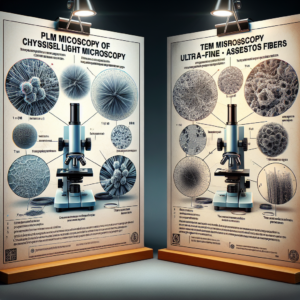
Polarized Light Microscopy (PLM)
PLM is the standard method for bulk material analysis and the most widely used test in residential and commercial property assessments. The microscope passes polarized light through the prepared sample. Different mineral types refract and absorb polarized light in characteristic ways — chrysotile produces a distinctive silky, curvilinear fiber appearance, while amphibole types like amosite appear straighter and more needle-like.
PLM is fast (results often within 24 hours), relatively affordable ($25–$75 per sample at most accredited labs), and sufficient for most building material assessments. Its limitation is fiber size — PLM cannot reliably detect fibers below approximately 0.25 micrometers in diameter.
Transmission Electron Microscopy (TEM)
TEM fires a beam of electrons through an ultra-thin sample slice. The resulting image resolves individual fibers at the nanometer scale — far beyond what light-based microscopy can achieve. TEM also allows energy-dispersive X-ray analysis (EDAX), which identifies the elemental composition of individual fibers to confirm asbestos type with near-certainty.
TEM is the required method for post-abatement clearance air testing under EPA AHERA regulations and for any analysis where PLM results are inconclusive. It is more expensive ($100–$300+ per sample) and takes longer, but it is the gold standard for accuracy in occupational and environmental exposure assessments.
The Health Consequences of Asbestos Exposure — What the Clinical Picture Actually Looks Like
Asbestosis
Asbestosis is a chronic, progressive fibrotic lung disease caused by long-term inhalation of asbestos fibers. The fibers trigger an inflammatory response in the alveoli that, over years, leads to irreversible scarring (fibrosis). Patients typically present with progressive exertional dyspnea, a persistent dry cough, and characteristic “Velcro crackles” on auscultation of the lung bases.
Latency period before clinical symptoms: typically 20–30 years post-exposure.
Mesothelioma
Malignant pleural mesothelioma is the most severe asbestos-related cancer. It affects the mesothelial lining of the lung (pleura), abdomen (peritoneum), or heart (pericardium). Because it is almost exclusively caused by asbestos exposure and has a latency period of 30–50 years, many patients have no memory of the exposure event that caused their disease.
Median survival after diagnosis without treatment is approximately 9–12 months. Even with aggressive multimodal treatment, 5-year survival rates remain below 10% for most histological subtypes.
Lung Cancer
Asbestos exposure increases lung cancer risk independently of smoking. In smokers with significant asbestos exposure, the two risk factors multiply rather than simply add — the combined risk is roughly 50–90 times that of a non-smoking, unexposed individual.
Pleural Plaques and Pleural Effusion
These are more common findings on imaging in exposed individuals and, while not cancerous themselves, serve as markers of significant historical exposure. Their presence on a chest X-ray or CT scan typically prompts a more detailed occupational history review.
Clinical Insight: What Practitioners Actually Observe
Several patterns emerge consistently in the clinical management of asbestos-related disease that standard informational articles rarely capture.
The Diagnosis Delay Problem
Mesothelioma and asbestosis are frequently misdiagnosed on initial presentation. Asbestosis is often attributed to COPD or idiopathic pulmonary fibrosis, particularly in patients who do not spontaneously report occupational history. Clinicians working in regions with historically high industrial or shipyard activity should maintain a lower threshold for asbestos exposure inquiry, even in patients presenting decades after retirement.
Occupational History Is Rarely Volunteered
Patients frequently do not connect current respiratory symptoms to a construction job they held in their 30s. A thorough occupational history — including trades, industries, and the types of buildings worked in — is essential and often missed in routine consultations.
“Low-Level” Exposure Is Not Low Risk
There is no established safe threshold for asbestos exposure. Even brief, incidental exposures — a few weeks of renovation work, living near an industrial facility — can be sufficient to cause disease in susceptible individuals. This is an important point that contradicts the intuition many patients (and some clinicians) bring to these conversations.
Secondary Exposure Is Underrecognized
Family members of asbestos workers have developed mesothelioma from fibers carried home on work clothing. This para-occupational exposure mechanism is well-documented in the literature but rarely discussed in general health education.
Choosing an Accredited Laboratory — What Accreditation Actually Means in Practice
Not all laboratories that offer asbestos testing are qualified to perform it to a regulatory standard. In the United States, the relevant accreditation body is NVLAP (National Voluntary Laboratory Accreditation Program), administered by NIST. In the UK, the equivalent is UKAS accreditation under ISO/IEC 17025.
Accreditation requires laboratories to:
- Participate in proficiency testing programs (sometimes called “round-robin” testing), where they analyze blind samples with known asbestos content and must match the established results within defined tolerances
- Maintain documented quality management systems
- Use calibrated, verified equipment
- Employ analysts with specific, verifiable training credentials
Before submitting samples, verify the laboratory’s NVLAP accreditation number and confirm that the accreditation covers the specific test type you need. A lab accredited for PLM bulk analysis may not hold separate accreditation for TEM air analysis.
Symptoms and Warning Signs of Asbestos-Related Disease
Asbestos-related conditions are insidious precisely because early symptoms are vague and easy to attribute to other causes.
Respiratory Symptoms to Watch For:
- Progressive shortness of breath, initially only on exertion, later at rest
- Persistent dry cough that does not resolve with standard treatment
- Chest tightness or chest pain (particularly with pleural involvement)
- Unexplained weight loss in the context of any of the above
- Finger clubbing (a late sign of significant pulmonary fibrosis)
Important Variation: Pleural mesothelioma often presents first with a large pleural effusion — fluid around the lung — causing sudden breathlessness. This is frequently the presenting symptom that brings patients to medical attention, by which point the disease is typically already advanced.
Diagnosis: What Tests Are Used in Clinical Settings
Asbestos-related diagnosis in a clinical setting is not a single test — it is a convergence of evidence.
| Diagnostic Tool | What It Detects | Limitation |
|---|---|---|
| Chest X-ray | Pleural plaques, diffuse pleural thickening, interstitial changes | Misses early disease; operator-dependent |
| High-Resolution CT (HRCT) | Early fibrosis, pleural lesions, nodules | Radiation exposure; cannot confirm fiber type |
| Lung function tests (spirometry) | Restrictive pattern in asbestosis | Non-specific |
| Bronchoalveolar lavage (BAL) | Asbestos bodies in lung fluid | Confirms exposure history, not specific diagnosis |
| Pleural biopsy | Confirms mesothelioma histologically | Invasive; requires specialist |
| Tissue immunohistochemistry | Differentiates mesothelioma from adenocarcinoma | Requires experienced pathologist |
There is no blood test that detects asbestos fibers. Serum mesothelin-related peptides (SMRP) are used as a biomarker in mesothelioma monitoring but are not a screening tool.
Treatment Options for Asbestos-Related Conditions
Asbestosis
There is no cure for asbestosis. Management focuses on slowing progression and managing symptoms:
- Smoking cessation (critical — it dramatically accelerates progression)
- Pulmonary rehabilitation
- Supplemental oxygen therapy as disease advances
- Influenza and pneumococcal vaccination (to reduce infection risk)
- In end-stage disease, lung transplantation may be considered for eligible patients
Mesothelioma
Treatment depends on stage, histological subtype (epithelioid, sarcomatoid, biphasic), and patient fitness. Options include:
- Surgery (extrapleural pneumonectomy or pleurectomy/decortication) — for resectable, early-stage disease
- Chemotherapy (cisplatin + pemetrexed remains the standard first-line regimen)
- Immunotherapy (nivolumab + ipilimumab approved in some jurisdictions for first-line treatment)
- Palliative care — the primary focus in the majority of cases at diagnosis
Lung Cancer Related to Asbestos
Treated under standard lung cancer protocols (surgery, chemotherapy, targeted therapy, immunotherapy depending on histology and molecular markers), with the additional consideration that asbestos exposure history is relevant to legal compensation claims in many jurisdictions.
Prevention and Practical Risk Reduction
The most important prevention strategy is accurate identification before disturbance — which brings the conversation back to laboratory testing.
For Property Owners:
- Commission a professional asbestos survey before any renovation, demolition, or significant maintenance work in pre-1985 buildings
- Do not disturb suspected materials pending testing results
- Keep documentation of all survey and test results — these are legal records
For Workers:
- Know your rights under OSHA asbestos standards (29 CFR 1910.1001 for general industry, 29 CFR 1926.1101 for construction)
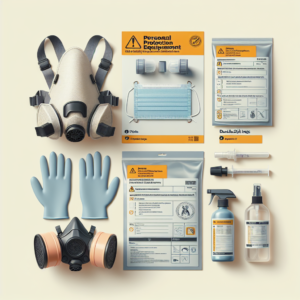
- Use appropriate respiratory protection (minimum P100 half-face respirator; full PAPR for high-disturbance tasks)
- Do not bring work clothing home unwashed
For Sample Collection (If Required):
- Wear an N100 or P100 respirator and nitrile gloves
- Mist the material lightly with water containing a drop of dish soap before sampling — this suppresses fiber release significantly
- Take a small sample (thumbnail-sized is sufficient for PLM bulk analysis)
- Double-bag in heavy-duty zip-lock bags, seal with tape, and label with date, location, and material type
- Use a certified chain-of-custody submission form
When to See a Doctor — Urgency Signals
Seek medical evaluation promptly if:
- You have known or suspected occupational asbestos exposure and develop any new respiratory symptoms
- You experience unexplained progressive breathlessness over weeks to months
- A chest X-ray or CT done for any reason shows pleural thickening, pleural effusion, or interstitial changes
- You develop chest pain that is not clearly musculoskeletal in origin
Do not wait for symptoms to become severe. Asbestos-related diseases are diagnosed late by default — early specialist referral, even for surveillance, improves outcomes.
Interpreting Your Laboratory Report
When results come back, the terminology can be unfamiliar.
Fiber types you may see listed:
- Chrysotile — white asbestos; most common in building materials
- Amosite — brown asbestos; common in ceiling tiles and insulation board
- Crocidolite — blue asbestos; considered most hazardous due to fiber geometry
- Tremolite, anthophyllite, actinolite — less commercially used but genuinely hazardous
Result interpretations:
- “ND” or “None Detected” — no asbestos found in that specific sample; does not guarantee the entire material is clear
- “>1% chrysotile” — the material meets the regulatory definition of ACM; specific handling and disposal requirements now apply
- “Trace” results — percentages below 1% but above detection limit; may still require precautionary management depending on condition and disturbance risk
Keep all reports permanently. They are relevant to property transactions, insurance, occupational health records, and potential future legal claims.
Key Takeaways
- Asbestos cannot be identified visually under any circumstances — laboratory analysis is the only reliable method
- PLM is standard for bulk material testing; TEM is required for air clearance and high-accuracy scenarios
- Asbestos-related diseases have latency periods of 20–50 years, making early identification a genuine long-term health investment
- No safe threshold for asbestos exposure has been established — brief or low-level exposure carries real risk
- Accreditation (NVLAP in the US, UKAS in the UK) is non-negotiable when selecting a laboratory
- Secondary (para-occupational) exposure via contaminated clothing is a documented disease pathway
- Clinical diagnosis requires convergence of occupational history, imaging, and often invasive biopsy — there is no blood test for asbestos
Frequently Asked Questions
Can I test for asbestos myself?
Home test kits provide collection tools but not analysis. You still need to send the sample to an accredited laboratory. More importantly, improper collection — breaking, drilling, or dry-sanding a suspected material — releases fibers directly into your breathing space. Hire a licensed inspector for collection whenever possible.
How much does asbestos testing cost?
PLM bulk analysis typically runs $25–$75 per sample at accredited labs. TEM air analysis for post-abatement clearance generally starts at $100–$300 per sample. Rush turnaround (2–4 hours at some labs) is available at a premium.
How long do results take?
Standard turnaround is 24–48 hours for PLM. TEM takes slightly longer due to sample preparation. Most accredited labs offer expedited services.
The test came back positive. What now?
If the material is intact and undisturbed, the standard recommendation is encapsulation and ongoing monitoring rather than immediate removal. Removal itself is a disturbance event that generates fiber release — it must be performed by a licensed abatement contractor under controlled conditions. Removal should be prioritized when the material is damaged, deteriorating, or in an area where renovation is planned.
Is crocidolite (blue asbestos) more dangerous than chrysotile?
Crocidolite fibers are straighter, thinner, and more biopersistent in lung tissue than chrysotile, which is why they are associated with higher rates of mesothelioma per unit exposure. However, regulatory and clinical guidance treats all asbestos types as carcinogenic with no safe exposure level. The distinction is of research relevance but should not encourage any perception that chrysotile is “safe.”
Can asbestos exposure be detected in a blood test?
No. Serum mesothelin (SMRP) is used as a monitoring biomarker in diagnosed mesothelioma, not as a screening tool. Environmental exposure is confirmed through occupational history, imaging, and when necessary, bronchoalveolar lavage or tissue biopsy.
What is chain of custody and why does it matter?
Chain of custody is a documented record of every person who handled a sample from collection through final reporting. It is required for laboratory results to be used in legal proceedings, regulatory enforcement actions, or formal occupational health assessments. Always request and retain the chain of custody document with your results.
Medical and Regulatory References
- World Health Organization (WHO) — Asbestos: Elimination of Asbestos-Related Diseases (WHO Fact Sheet)
- U.S. Environmental Protection Agency (EPA) — Asbestos Laws and Regulations, EPA.gov
- National Institute for Occupational Safety and Health (NIOSH) — Asbestos, CDC.gov/niosh
- Tossavainen A. — Asbestos, asbestosis, and cancer: the Helsinki criteria for diagnosis and attribution (Scand J Work Environ Health, 1997)
- Bianchi C, Bianchi T. — Malignant mesothelioma: global incidence and relationship with asbestos (Industrial Health, 2007)
- Occupational Safety and Health Administration (OSHA) — Asbestos Standards for Construction (29 CFR 1926.1101), OSHA.gov
This article was reviewed by Dr. Urooj Fatima and is intended for educational and public health awareness purposes only. It does not replace professional medical advice, environmental assessment, or legal guidance.