Physical Address
304 North Cardinal St.
Dorchester Center, MA 02124
Physical Address
304 North Cardinal St.
Dorchester Center, MA 02124
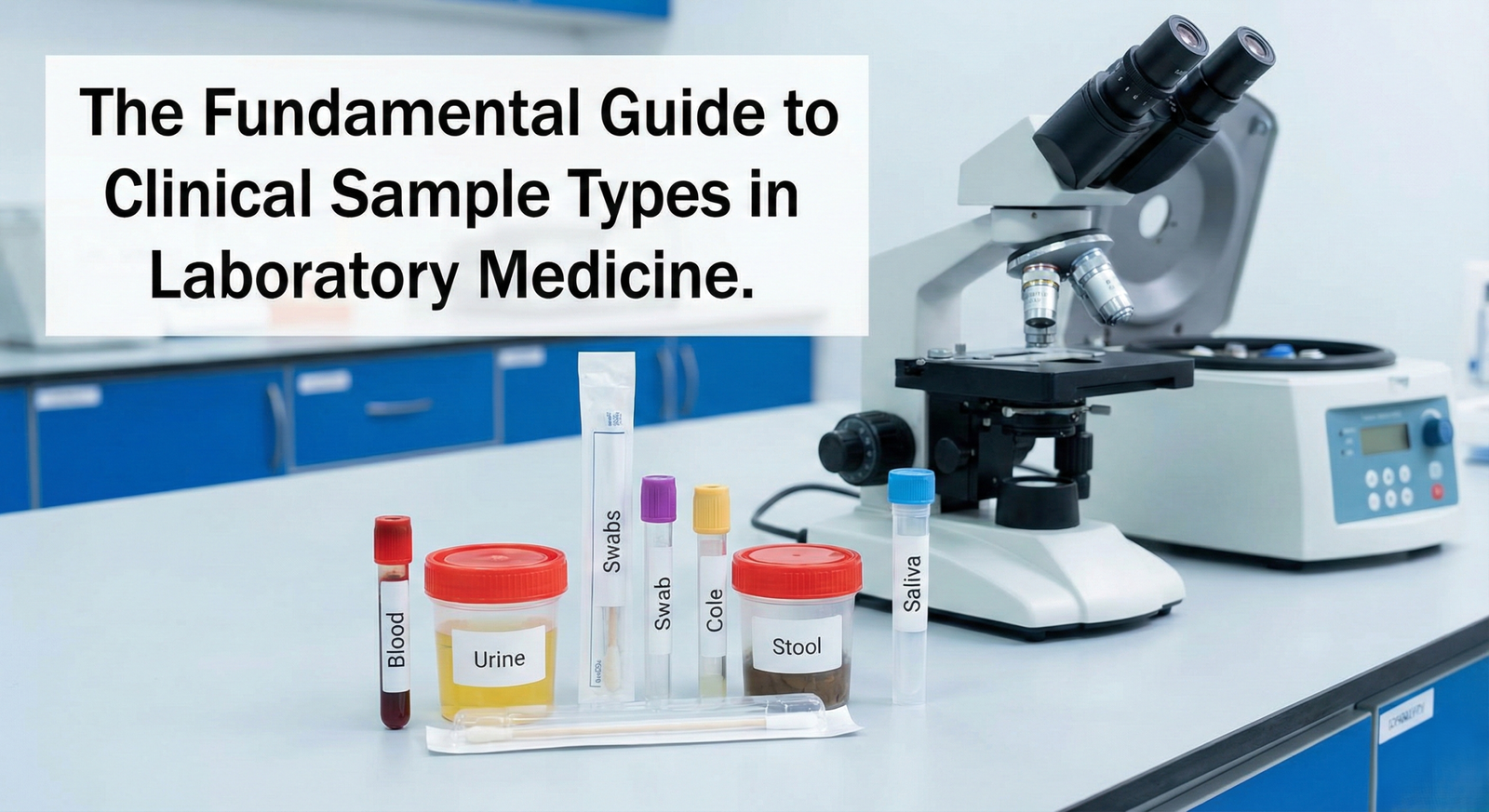
As daunting and intricate as healthcare might be, diagnostics is the primary factor which successful treatments rely on. Laboratory medicine is the key element here, a discipline which is devoted to choosing, doing, and interpreting diagnostic tests. Nevertheless, the correctness of test results depends solely on the quality and kind of collected specimens. For Laboratory Professionals, mastering the different clinical sample types is not only a technical skill; it’s an absolute necessity for patient safety.
This manual walks through the various clinical samples found in a contemporary diagnostic environment, presenting the methods, storage, and the importance of the Medical Lab Scientist, Lab Technician, and Laboratory Technologist in providing diagnostic precision.
It is necessary to comprehend the human system behind the samples before learning about different kinds of samples. A clinical laboratory is a place where a hierarchy of highly educated and skilled people is working. Usually, the Medical Lab Scientist (MLS) is a holder of a four-year degree and is in charge of doing complicated analyses, interpreting data, and verifying results. Next to the MLS is a Laboratory Technologist, whose job description is similar in most areas to the MLS, but more concentrated on the technical side of the assays and the use of advanced instruments.
Backing up these positions is a Lab Technician, who is, in most cases, the support of specimen processing and performance of routine testing. The Lab Technician is usually the one who is closest to a sample, thus he/she ensures that a sample is properly labeled, centrifuged, and prepared for analysis. Laboratory Professionals together are not only the cohort that moves the field of Medical Lab Technology onwards but also they are the main drivers of Medical Lab Technology.
Blood is the most common specimen that is being analyzed within Laboratory medicine. It is a vibrant indicator of the body’s physiological state since it carries oxygen, nutrients, hormones, and waste products.
Whole blood comprises all of the blood’s cellular and fluid parts. A Medical Lab Scientist utilizes whole blood to execute Complete Blood Counts (CBCs) which are done to evaluate red blood cells, white blood cells, and platelets. In this case, Medical Lab Technology has reached its peak due to the fact that it is now possible for automated analyzers to do the count of cells in a matter of seconds.
Once whole blood is being spun in a centrifuge and no anticoagulants are added, the resulting liquid is plasma. Since plasma contains clotting factors, it is a must for coagulation studies (blue top tubes).
Where blood is left to clot prior to being spun, the liquid obtained is called serum. Serum does not contain clotting factors, like fibrinogen, but is still the gold standard for many chemistry and immunology tests. Laboratory Professionals use serum for antibody testing and therapeutic drug monitoring. The Lab Technician is instrumental here making sure that the sample is not rushed or overdone and that the sample is allowed the adequate time to clot before processing so that fibrin clots which can clog the sensitive machinery are not formed.
Urine could be considered as the second most frequent sample in Laboratory medicine. It is an easy-to-get specimen that can tell a lot about kidney function, metabolic diseases (such as diabetes), and urinary tract infections.
A random urine sample is good enough for a general check-up. Nevertheless, for quantitative analysis, e.g., protein or creatinine clearance measurement, a 24-hour urine collection is mandatory. This depends entirely on the patient’s compliance and also on the clear instruction coming from the Laboratory Professionals. A Medical Lab Scientist will be measuring the total volume and concentration to calculate filtration rates of the kidney.
This manual skill is at the core of Medical Lab Technology and requires a very well-trained eye for differentiation between a non-harmful crystal and a pathological cast pointing to renal failure.
Apart from blood and urine, the most common samples for Laboratory Professionals to analyze are fluids coming from sterile body cavities.
Since the cells deteriorate fast in CSF, the Laboratory Technologist has to handle it absolutely straightaway. A Medical Lab Scientist will count the cells and do the differential stain to recognize bacteria or atypical white blood cells.
These fluids are pleural (lung), pericardial (heart), and peritoneal (abdominal). The building up of these fluids (effusion) is a sign of disease. The Medical Lab Scientist is the detective here who links the chemical markers like LDH and protein to the findings in the cells.
Synovial fluid gets into joint cavities, the analysis of which is necessary for identifying gout and septic arthritis. Crystals (monosodium urate) can most of the time be found by a Laboratory Technologist who is using polarizing microscopy – a Medical Lab Technology specialized technique.
The role of microbiology in Laboratory medicine has never been as vital as during the era of antibiotic resistance. Microbiology specimens can be the swabs taken from wounds, throat, or nasopharyngeal areas, and also sputum and stool samples.
The emphasis is on the collection method. An incorrectly taken swab will grow normal skin flora instead of the pathogen which is the cause of the infection. The Lab Technician is the one who usually initiates these cultures on agar plates. After bacterial growth is visible, the Medical Lab Scientist carries out the identification and antibiotic susceptibility testing.
Advanced Medical Lab Technology has increasingly been leaning towards the molecular methods i.e. PCR (Polymerase Chain Reaction). This enables Laboratory Professionals to identify viral DNA/RNA (for example, COVID-19 or Influenza) directly from a swab without the need to wait for a culture to grow. The Laboratory Technologist who is handling these molecular platforms needs to have undergone specialized training in contamination control and molecular biology.
Though mostly classified as a separate department, tissue analysis remains a crucial component of Laboratory medicine.
Small tissue samples that have been taken for diagnosis are preserved in formalin. While it is a pathologist (doctor) who makes a diagnosis on the slide, the work of preparing the samples is done by highly skilled Laboratory Professionals called histotechnologists. Nevertheless, in small labs, a multi-skilled Laboratory Technologist may be able to help with specimen accessioning.
Cell-based samples from Paps or Fine Needle Aspirates (FNAs) refer to cells in suspension rather than a solid tissue. The Medical Lab Scientist or cytotechnologist examines these slides for cancerous or precancerous changes.
Nevertheless, automation cannot take the place of the Medical Lab Scientist. What it does is to allow them to concentrate more on the abnormal results. The Laboratory Technologist or Scientist is the one who should look into the matter when an analyzer indicates that a result is abnormal. Is the sample clotted? Is it lipemic (fatty)? Was it taken from an IV line? These are the laboratory troubleshooting skills that separate highly skilled Laboratory Professionals from the rest.
Along with high-level automation, the Lab Technician is still needed for tasks such as instrument maintenance, reagent inventory, and manual processing of non-standard samples that cannot be done by machines.
It is a well-known axiom in Laboratory medicine that “Garbage In, Garbage Out.” According to research, more than 70% of laboratory errors are made in the pre-analytical stage which is the time before the sample even gets to the analyzer.
Laboratory Professionals are the gatekeepers of quality. In case a Medical Lab Scientist is given an unlabelled specimen, he/she is obliged to follow strict protocols in order to reject it whether or not there is pressure from clinical staff.
Sample integrity is ensured through the efforts of all those involved. The Laboratory Technologist must make certain that temperature is under control while the Lab Technician is responsible for ensuring that the correct centrifugation speeds are used. Strict compliance with standards is the feature of an ethical Medical Lab Technology practice.
| Role | Education & Responsibilities |
| Lab Technician | Generally, an associate degree or certificate is required. Focuses on the pre-analytical processing, phlebotomy, and performing routine tests under the direction of a supervisor. They are the logistical engines of the lab. |
| Laboratory Technologist / Medical Lab Scientist | Depending on the country, these names are used interchangeably (e.g., MLS in the USA, Technologist in Canada/others). They usually have a bachelor’s degree. They carry out high complexity testing, manage quality control, and perform method validation. They are the analytical brains of the lab. |
| Laboratory Professionals | A cover term for all the above-mentioned persons plus phlebotomists, lab assistants, and pathologists. |
All these positions constitute the backbone of Laboratory medicine, each offering a different contribution to the patient care.
Medical Lab Technology‘s next step is largely towards “Liquid Biopsies”—just a simple blood draw to detect cancer DNA—and Point-of-Care Testing (POCT). By means of POCT, Laboratory medicine gets closer to the patient, bedside. Although nurses are the ones who perform these tests most of the time, Laboratory Professionals manage and calibrate them.
It is usually a Medical Lab Scientist who takes over the responsibility of the POCT coordinator, thus making sure that the devices for glucometers and blood gas analyzers employed by non-lab staff deliver accurate results. This opens up the possibilities of the Laboratory Technologist‘s role to be outside the four walls of the laboratory, thus getting more integration with the clinical care team.
Besides that, AI incorporation is supporting the Laboratory Professionals in recognizing complex patterns in hematology and genomics, which is the dawn of a new era where the Medical Lab Scientist works hand in hand with the algorithms to achieve diagnostic precision.
The wide range of clinical samples—the most common being a blood vial and the rarest drops of spinal fluid—are the different pieces of the puzzle, which is the human body. Each of them has its own story, a part of the puzzle that doctors need to diagnose and treat patients effectively.
The capability of these stories depends on the dedicated Laboratory Professionals. Whether it is the Lab Technician who is meticulously labeling a tube, the Laboratory Technologist who is sustaining the high-tech analyzers, or the Medical Lab Scientist who is interpreting the important leukemia smear, their combined knowledge is what ensures the patient’s safety and welfare.
That is why having thorough knowledge of sample types is still the basis of excellence in Laboratory medicine.