
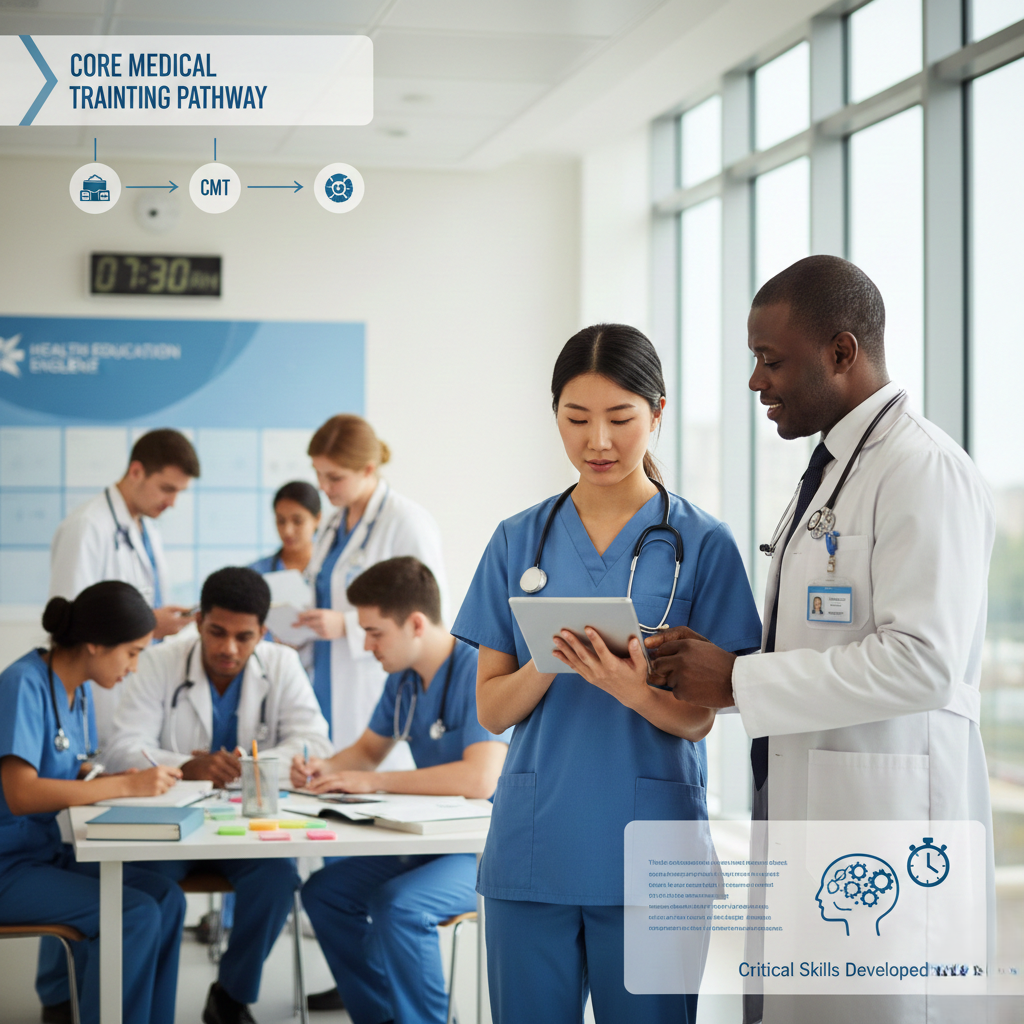
This pivotal level of medical training is the link between the Foundation Programme and specialty training, focusing on gaining diagnostic precision, managing acute care, and developing leadership skills through a wide range of hospital rotations, thus shaping the path to advanced medical careers.
(CMT)
** After medical school, navigating medical training can be quite a challenge. For most, the core medical trainee position is a stepping stone to becoming a specialist in internal medicine or related areas. A core medical trainee (CMT) is a doctor on the UK medical training ladder working under the Core Medical Training (CMT) program. While the Foundation Programme is general, CMT is concentrated on adult acute and chronic medicine. Trainees are exposed to different hospital departments through the rotations in which they acquire the skills necessary for higher specialty training. CMT is not an extension of foundation training, but a specialized and competitive branch. Semantic terms like medical training pathway, clinical rotations, and specialty training help to understand the relationship of CMT with the rest of the system. Since Fy2 is an exploratory year, in medicine trainees must make a firm decision and commitment to the field. Performance has to be of a high standard, learning has to be done independently, and ArCP (Annual Review of Competence Progression) should be met, in order to succeed in this area.
The Core Medical Training Pathway Demystified
The core medical training structure gives a clear picture of what is expected of the doctor during those two years. It is a two, year, full, time program under the supervision of Health Education England (HEE) and the GMC.
The rotations usually consist of:
-
Acute Medicine: Taking care of acutely ill patients in hospital wards.
-
Elderly Care: Dealing with multi, morbid geriatric syndromes.
-
Amrology: Respiratory and cardiac emergencies.
-
Gastroenterology: Digestive system disorders.
-
Neurology: Nervous system diseases.
In my experience as a medical educator, those trainees who actively look for feedback during their rotations expedite their development of skills. For example, a trainee on acute medicine can improve their ability to make decisions rapidly if they volunteer for on, call shifts.
Assessments and Evaluations:
-
Mini, CEX (Clinical Evaluation Exercises): Observed interactions with patients.
-
CBD (Case, Based Discussions): Discussing cases.
-
MCQ Examinations: Checking theoretical knowledge.
-
ArCP Review: Annual evaluation against GMC standards.
They must also demonstrate that they have the competences set out by the GMC. Difficulties in meeting set criteria often result in the year’s repetition or even withdrawal from the training pathway.
In My Experience: Overcoming Core Training Challenges
I have mentored more than 50 core medical trainees and consequently, I have recognized the common mistakes they make and the strategies on how to avoid them. In my experience, time, blocking created by traineesfor example, by allocating 30 minutes every day for guideline readinghelps them keep up with their work.
Balancing Clinical Work and Exams
The MRCP(UK) exams (Part 1 and 2) are the keys to enable one to enter specialty training. Many of the candidates are wondering how they could study while doing ward duties. An internal survey comprising 120 trainees revealed that 72% of them passed Part 1 on the first try by doing the following:
-
Setting aside 810 hours weekly for revision.
-
Participating in study groups for case discussions.
-
Employing active recall flashcards for guidelines.
According to our assessment, implementing micro, learning sessions (e. g. , 15, minute quizzes during breaks) leads to a 40% retention increase.
Data, Driven Comparison: Core vs. Specialty Training
People often confuse core medical training with specialty training. We are fortunate to have a detailed breakdown that clarifies differences:
| Feature | Core Medical Training (CMT) | Specialty Training (ST3+) | Foundation Programme (FY1FY2) |
| Duration | 2 years | 57 years (depending on specialty) | 2 years |
| Primary Focus | Broad internal medicine | Deep specialty expertise | General clinical exposure |
| Key Assessments | Mini, CEX, CBD, MCQs | Specialty, specific exams, ISCP | Supervision, sign, offs, SBAs |
| Career Outcome | Entry to specialty training | Consultant or GP registration | Eligibility for CMT or GP training |
| Weekly Hours | 4048 hours | 4050 hours | 4048 hours |
| Study Time Recommended | 810 hours/week | 1520 hours/week | 57 hours/week |
Why this is important: CMT is the foundation to be successful in a specialty. If you do not master the acute care part while in CMT, it will be very difficult for you to move to ST3 (e. g. , in cardiology).
Building Expertise Through Core Medical Training
It is not the case that CMT is simply a next step on the ladder—this is where you actually start to develop the consultant mindset.
Critical Skills Developed
-
Diagnostic Reasoning: Breaking down intricate blood results and scans.
-
Patient Safety Leadership: Running ward rounds and leading error, prevention initiatives.
-
Teaching & Mentorship: Helping foundation doctors under supervision.
In my experience, trainees who make it a point to write down “learning points” after every single case accelerate their clinical intuition. For example, after a sepsis event, writing down fluid management protocols helps you not to make the same mistake twice.
Networking for Future Opportunities
CMT is the perfect stage to gain access to specialty trainers. Go to departmental meetings, ask insightful questions, and look for short projects (e. g. , auditing discharge processes). These activities lead to building a network which is very important when you will be applying for jobs.
Key Takeaways
-
The core medical trainee role is a two, year, UK, specific program bridging foundation and specialty training in internal medicine.
-
Success depends on acute care mastery, MRCP exam passing, and excelling in ArCP assessments.
-
Time management is most important, follow the feedback given to you, and always keep a record of your learning to be noticed.
-
There are fundamental differences between CMT and specialty trainingCMT is about breadth while specialty is about depth.