
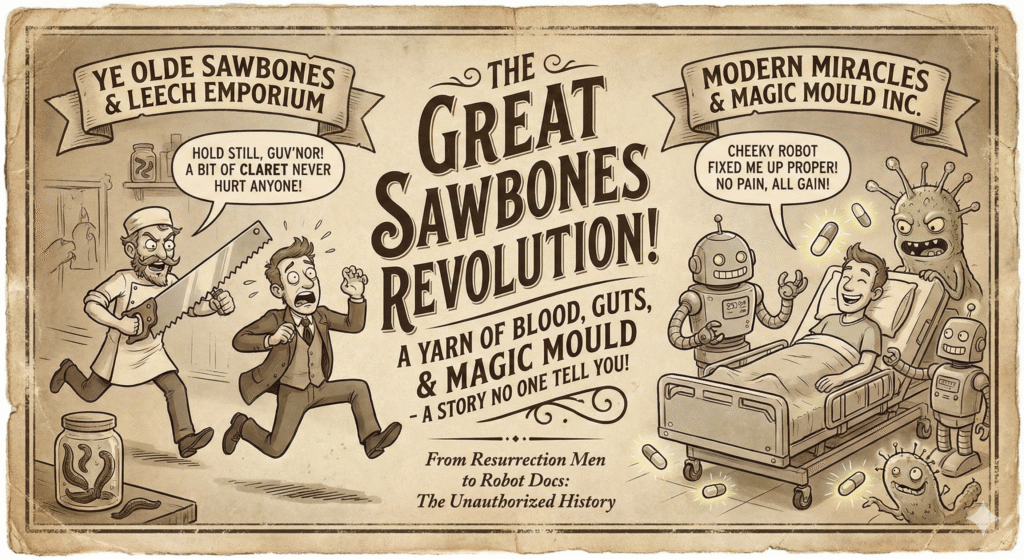
The most concrete proof of the medical revolution (Parts III, V, and VI) is the shift in what actually kills people in developed countries. We conquered the „invisible nasties,“ only to face diseases of longevity.
| Era/Time Period | Top 3 Causes of Death | Disease Type |
| 1900 (Pre-Antibiotics) | 1. Pneumonia/Influenza | Infectious |
| 2. Tuberculosis (Consumption) | Infectious | |
| 3. Diarrhea/Enteritis | Infectious | |
| 2023 (Modern Era) | 1. Heart Disease | Chronic/Degenerative |
| 2. Cancer (Malignant Neoplasms) | Chronic/Degenerative | |
| 3. Accidents/Unintentional Injuries | External/Preventable |
The Result: Infectious diseases, once responsible for killing the „average bloke before 35,“ now barely crack the top five. This is the ultimate success story of sanitation, vaccines, and the „Magic Mould“ (Penicillin).
2. The Anesthesia & Surgery Revolution (Part IV)
The shift from a 30-second amputation to complex internal surgery enabled by „The Big Sleep“ is quantifiable in the number and complexity of procedures performed today.
-
Global Surgical Volume: An estimated 310 million major surgical procedures are performed worldwide each year.
-
Safety Improvement: The risk of dying during a major surgery has dropped dramatically. In the mid-19th century, mortality rates for major procedures (like an amputation) could be over 50%. Today, the overall perioperative mortality rate in developed countries is generally below 1%.
3. The Modern Industry’s Footprint
The global apparatus needed to sustain this level of health is enormous, reflecting the colossal business that grew out of the scientific breakthroughs.
-
R&D Investment: Pharmaceutical companies globally spend hundreds of billions on R&D. In 2022, estimated R&D spending by biopharma companies reached nearly $240 billion.
-
Global Vaccine Market: The market for vaccines (the modern form of „teaching your body kung-fu“) is projected to reach over $100 billion in value annually by the end of the decade, highlighting the massive investment in prevention.
-
Medical Technology (Robots & Voodoo): The global medical device market (the „pinging machines“ and robots) is valued at well over $500 billion, constantly driving new revolutions in diagnostics and surgical techniques.
4. Life Expectancy and Equity
While we live in a golden age, the benefits of the revolution are not perfectly distributed. This points to the ongoing challenges in the modern medicine industry: access and equity.
| Population Group (2020, US Example) | Life Expectancy at Birth (Years) | Context |
| Non-Hispanic White | 77.6 | Generally aligns with high-income global averages. |
| Non-Hispanic Black | 71.5 | Shows a significant disparity, reflecting systemic health issues. |
| Hispanic | 77.9 | Often shows higher life expectancy despite other socioeconomic factors. |
The gap highlights that the current revolution is not just about discovery, but about delivery—ensuring the „magic mould“ and „robotic surgery“ are available to all, regardless of background.
The modern medical industry is a sprawling, multi-trillion-dollar ecosystem, built directly upon the messy, hilarious, and tragic work of the barber-surgeons, body snatchers, and careless scientists you described.