Physical Address
304 North Cardinal St.
Dorchester Center, MA 02124
Physical Address
304 North Cardinal St.
Dorchester Center, MA 02124
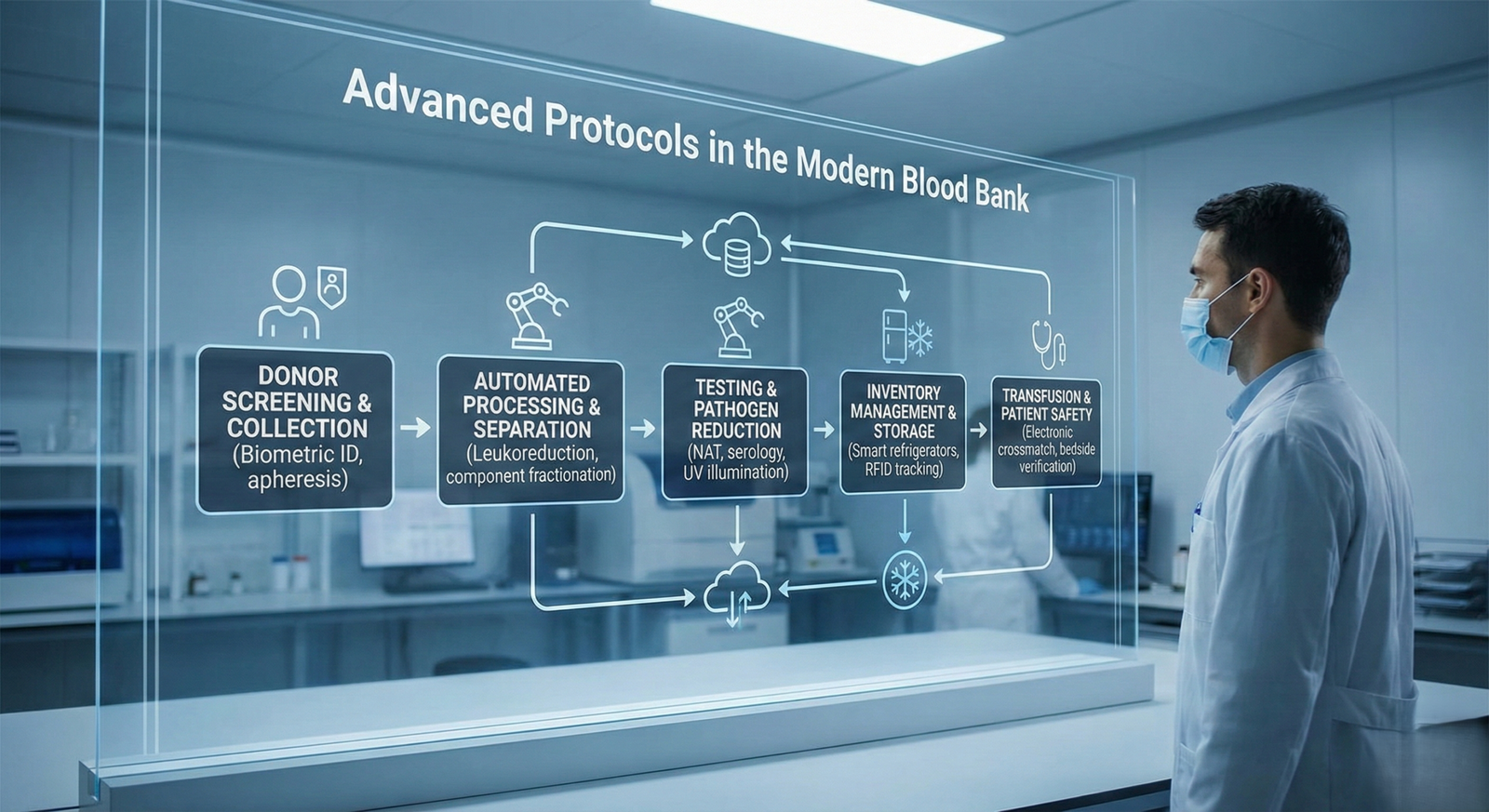
In fact, it is a high-risk logistics center for “liquid organ transplants.” Every blood unit transfused is biologically active tissue, capable of saving a life or, if used improperly, causing a disastrous immune system failure.
Transfusion medicine is the field of utmost precision. It is at the very border where genetics meet immunology. The blood bank does not merely “match types”; it deals with a very complex net of more than 300 red cell antigens to make a choice which one of them will not cause immune system activation in the recipient against the donor tissue.
This paper moves inward the blood bank machinery, delving into molecular genetics of grouping, serological safeguards of cross-matching, fractionation logic of component therapy, and forensic investigation of transfusion reactions.
These are not arbitrary markers; they are specific carbohydrate and protein molecules bound to the red blood cell (RBC) membrane.
The ABO system is determined by sugars.
The H-Antigen (The Scaffold): All human red cells come with a precursor chain terminating in fucose. This is the “H-Antigen.”
Group A: An enzyme (N-acetylgalactosaminyltransferase) attaches N-Acetylgalactosamine to the H-antigen.
Group B: One more enzyme (Galactosyltransferase) attaches Galactose to the H-antigen.
Group O (The Null Phenotype): The enzyme is inactive. The H-antigen is left unchanged. This is why Group O is the “Universal Donor“—it does not have the extra sugars that A or B immune systems would attack.
Why? Bacteria in the intestines have cell wall sugars identical to A and B antigens.
The Rule: A Group A individual has Anti-B antibodies. A Group O individual has both Anti-A and Anti-B.
Unlike ABO sugars, the Rh antigens are transmembrane proteins. The most immunogenic is the D-antigen.
Rh Positive: The presence of the D-protein.
Rh Negative: A complete deletion of the RHD gene.
Clinical Criticality: Just like ABO antibodies, Anti-D is not a naturally occurring one. It is only formed after exposure (transfusion or pregnancy). This is the reason for Hemolytic Disease of the Newborn (HDN), where an Rh-negative mother creates antibodies that attack her Rh-positive fetus.
Blood typing alone would not be enough in the blood bank. The actual transfusion has to be mimicked in vitro to be cross-checked. This is called the Cross-match.
This is the one single most important test in transfusion medicine.
The Mix: Patient Serum (Antibodies) + Donor RBCs (Antigens).
The Logic: “Will the patient’s immune system kill the donor cells?”
The Procedure Phases:
Immediate Spin: Attempts to reveal IgM antibodies (ABO incompatibility).
Incubation ($37^\circ \mathrm{C}$): Facilitates attachment of IgG antibodies.
Antiglobulin (Coombs) Phase: To detect the non-agglutinating IgG antibodies which have coated the cells, a reagent is introduced.
The Result: Any agglutination (clumping) or hemolysis is a FAIL. The unit is not allowed to be released.
The Mix: Patient RBCs + Donor Plasma.
The Logic: “Would the donor’s antibodies attack the patient?”
Type: Determine ABO/Rh.
Efficiency: In case of a negative screen, specific blood units are not cross-matched until the actual need for blood occurs. This helps to optimize blood bank inventory management.
Half a century back, the concept of “Whole Blood” was common among patients.The modern blood bank functions on the principle of Component Therapy: solving the specific problem.
By spinning whole blood in a centrifuge at certain speeds, we separate it into medically distinct parts.
| Component | Storage Condition | Shelf Life | Critical Note |
| Packed Red Blood Cells (PRBC) | $1^\circ \mathrm{C}$ to $6^\circ \mathrm{C}$ | 42 Days | Red cells metabolize glucose, use up ATP, and release Potassium ($K^+$) during storage (“Storage Lesion”). |
| Fresh Frozen Plasma (FFP) | $-18^\circ \mathrm{C}$ or colder | 1 Year | Contains all clotting factors but NO platelets. |
| Platelets | $20^\circ \mathrm{C}$ to $24^\circ \mathrm{C}$ (Agitated) | 5 Days | Stored at Room Temperature (Risk of bacterial growth). |
| Cryoprecipitate | $-18^\circ \mathrm{C}$ | 1 Year | Rich in Fibrinogen and Factor VIII (“The Super Glue”). |
Despite all precautions, reactions occur. The blood bank serves as the forensic investigator when a patient deteriorates during a transfusion.
The worst case scenario. Normally, it is a result of a clerical mistake (giving Group A blood to a Group O patient).
Mechanism: Patient IgM antibodies attack donor cells immediately. The complement system is activated.
Result: The destruction of the red cells within blood vessels (Intravascular hemolysis). The kidneys shut down due to hemoglobin toxicity. The patient gets “Impending Doom,” fever, and shock symptoms.
Lab Investigation: The Direct Antiglobulin Test (DAT) will be positive. The plasma will be pink (hemoglobinemia).
The primary cause of death due to transfusion-related problems.
Mechanism: “The victim counterattack.” Antibodies (anti-HLA) in the Donor’s plasma attack the Patient’s lung tissue (neutrophils in the lung capillaries) that results in destruction.
Symptoms: Extremely sudden shortness of breath (Pulmonary Edema) within 6 hours.
TACO vs. TRALI Differentiation: TACO is a case of the circulatory system being overloaded in which blood pressure is high (Hypervolemia). In contrast, blood pressure in TRALI is generally low.
Clerical Check: This is the major source of error
Visual Check: Match pre-transfusion plasma (yellow) with post-transfusion plasma (pink/red visualizes hemolysis).
The blood bank’s next step model is less and less reliant on humans.
Universal Blood Conversion: Researchers are employing bacterial enzymes to “cleanse” the A and B antigens from the red blood cells, thus, pretty much transforming Type A and B blood into Type O.
Molecular Genotyping: Instead of using serology (liquid mixing), the blood donor genotyping method that we are adopting now. It means not only ABO/Rh matching but also all minor antigens (Kell, Kidd, Duffy), thus, preventing alloimmunization in patients with chronic transfusions (like Thalassemia).
The blood bank is about the quiet watchfulness. From the enzyme kinetics of the ABO system to the thermal logistics of cryoprecipitate, every protocol is a life-saving firewall.