
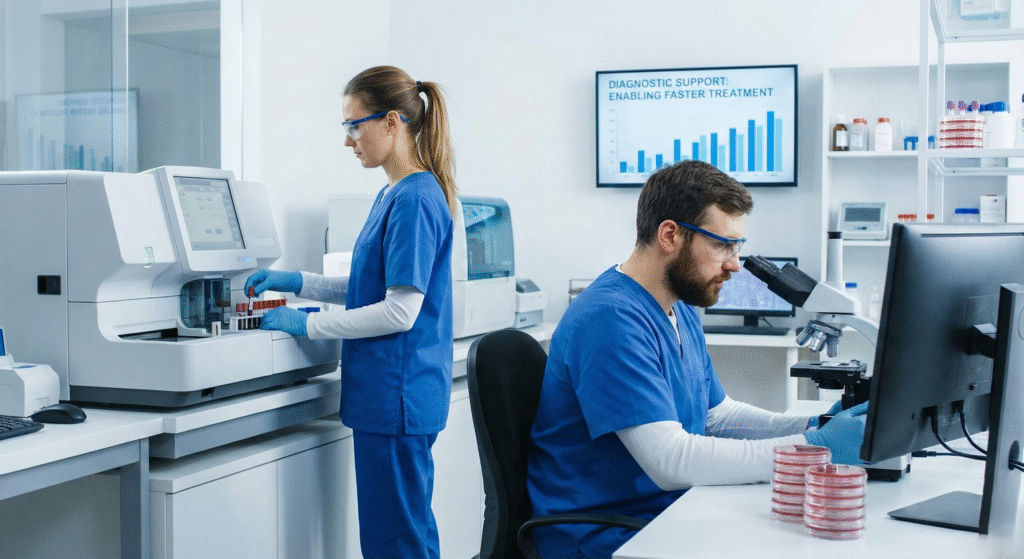
In a healthcare system that changes rapidly every day, the Medical Laboratory is the place where the most valuable—yet seldom recognized—work is done. While doctors diagnose and nurses provide direct care, these technically proficient people, which can be called Medical Lab Technologists or Medical Lab Scientists, are the ones who generate the core information that is quoted in more than 70% of clinical decisions in modern hospitals and clinics.
Even if they are rarely visible, their expertise in Laboratory Medicine influences the patient outcomes, the early recognition of diseases, and the effectiveness of treatment planning. The present article dwells upon the vital role these professionals take, the science they deal with, and how their input is still transforming the future of healthcare.
1. Silent Backbone of Healthcare
A Medical Lab Scientist is a person who runs the sophisticated machines, studies the specimens, and most importantly, looks into the results of tests that reveal what is going on inside the human body. These tests give the most objective data that a physical examination can never provide.
They do work that answers questions that can save lives such as:
-
Does the patient have an infection?
-
Are the kidneys working properly?
-
Is the blood count normal?
-
Are tumour markers elevated?
-
Is the medicine working well?
Without exact laboratory findings, present-day clinical practice would be incomplete, full of doubts, and in many instances, risky.
2. Why is Medical Laboratory Technology so Important?
Medical Laboratory Technology is a science that deals with the investigation of blood, urine, tissues, and other body fluids to find abnormalities. It is a fusion of Biology, Chemistry, Pathology, Microbiology, and advanced Technology aimed at revealing hidden disease patterns.
Its significance can be explained by three major foundations:
A. Earlier Disease Detection
Diseases such as diabetes, anemia, thyroid disorders, and infections have markers that can be detected long before symptoms appear. By doing regular checks, experts in Laboratory Medicine can spot the first warning signs that give patients the opportunity to get timely treatment.
B. Treatment and Progress Monitoring
Medical doctors cannot do without laboratory information to judge the effectiveness of a treatment. For instance:
-
Blood glucose tests help to monitor diabetes control
-
Viral load tests are used to keep track of HIV treatment
-
Liver function tests are the means to check drug side effects
3. The Daily Responsibilities of a Medical Lab Technologist
A Medical Lab Scientist is not just in charge of test tubes. Their work requires them to be very precise, have high-level technical skills, and use good scientific judgment.
A. Specimen Collection and Processing
They are responsible for making sure the specimen is:
-
Properly collected
-
Accurately labeled
-
Kept at the right temperature
-
Minimally processed to preserve quality
Only one mistake at this stage can cause incorrect results, and thus their precision is very important.
B. Manipulation of Sophisticated Medical Equipment
Such as:
-
Hematology analyzers
-
Chemistry analyzers
-
PCR machines
-
Immunoassay systems
-
Microscopes and slide scanners
Their technical skills guarantee that instruments deliver dependable results.
C. Performing Advanced Laboratory Tests
A Medical Lab Scientist carries out tests in the primary lab areas:
-
Hematology – blood counts, clotting studies
-
Microbiology – identification of bacteria, fungi, viruses
-
Biochemistry – glucose, hormones, enzymes, electrolytes
-
Molecular diagnostics – PCR, DNA/RNA testing
-
Immunology – autoimmune and allergy testing
-
Histopathology – tissue examination
Each one of these fields demands keen analysis and extensive scientific knowledge.
D. Interpreting and Reporting Results
Technologists look through the data for correctness, pinpoint mistakes, and verify that the results are logical from a medical point of view before they are given to the doctors. Their decisions help reduce misdiagnoses and the use of wrong treatments.
4. How Laboratory Medicine Improves Patient Care
The influence of Laboratory Medicine is not limited only to test tubes. It has a major role in every step of the patient care journey.
A. Guiding Accurate Diagnosis
Physicians depend on lab reports for confirmation and exclusion of diseases. For instance:
-
Patients with chest pain need cardiac enzymes
-
Patients with fever need CBC and cultures
-
Pregnant women need hormonal and genetic tests
-
Cancer patients need pathology and tumor markers
B. Reducing Medical Errors
One of the major causes of diagnostic errors that lead to preventable harm in healthcare is that healthcare providers don’t have enough data to support their diagnosis.
C. Enabling Personalized Medicine
The coming era of healthcare is personalized.
Laboratory results show:
-
Susceptibilities to be inherited
-
Drug reactions
-
Biological patterns that are specific to each person
Molecular diagnostics, which are run by Medical Lab Scientists, enable personalized medicine and treatment plans that are most effective with minimal side effects.
5. Human Expertise Behind the Technology
Although labs have greatly changed because of automation and robotics, human expertise is still necessary. Here are some of the reasons:
A. Machines Process Data, People Ensure Accuracy
Technologists confirm results before making them official.
If a result contradicts a patient’s condition, technologists have to investigate. They might:
-
Do the test again
-
Find errors in collection or processing
They utilize their scientific judgment to keep the patients safe from incorrect diagnoses.
6. The Role of Medical Lab Technologists in Public Health
Besides hospitals, laboratory professionals play a major role in protecting whole communities.
B. Screening Programs
Including:
-
Cancer
-
Genetic disorders
-
Metabolic disorders of infants
-
Chronic illnesses like diabetes
Some laboratories also test water, food, pollutants, and forensic samples, extending their reach beyond the health sector.
7. Biotechnology and the Future of Laboratory Medicine
A. Automation and AI
It is a continuous process to upgrade robots and AI in the following:
-
Work faster
-
Error finding
-
Trend analysis
-
Predictive diagnostics
B. Molecular and Genomic Testing
Today, advanced laboratories consider PCR, DNA sequencing, and gene profiling as routine work. These tests make it possible to:
-
Detect genetic disorders
-
Identify infectious diseases
-
Recognize cancerous mutations
C. Point-of-Care Testing
There are mobile diagnostic instruments that make it possible to have tests done right away, whether in ambulances, clinics, or remote areas. Nevertheless, the validation and interpretation of results by professionals are still a must.
Conclusion: The Heart of Scientific Health Care
Today, medicine is a collaborative effort, in which Medical Lab Technologists are scientifically central. By the fields of Medical Laboratory Technology and Laboratory Medicine, they are the enablers of the core data that is the basis for diagnosis, treatment, and prevention.
They do:
-
Life saving
-
Healthcare quality improving
-
Disease detection enhancing
-
Clinical decision-making supporting
-
Medical innovation driving
Though their presence is mostly invisible to patients, the role of the Medical Lab Scientist is one of the most life-saving in the whole healthcare system. As a result of technological advancement and new medical problems, their knowledge will be even more necessary in determining the direction of future healthcare.