
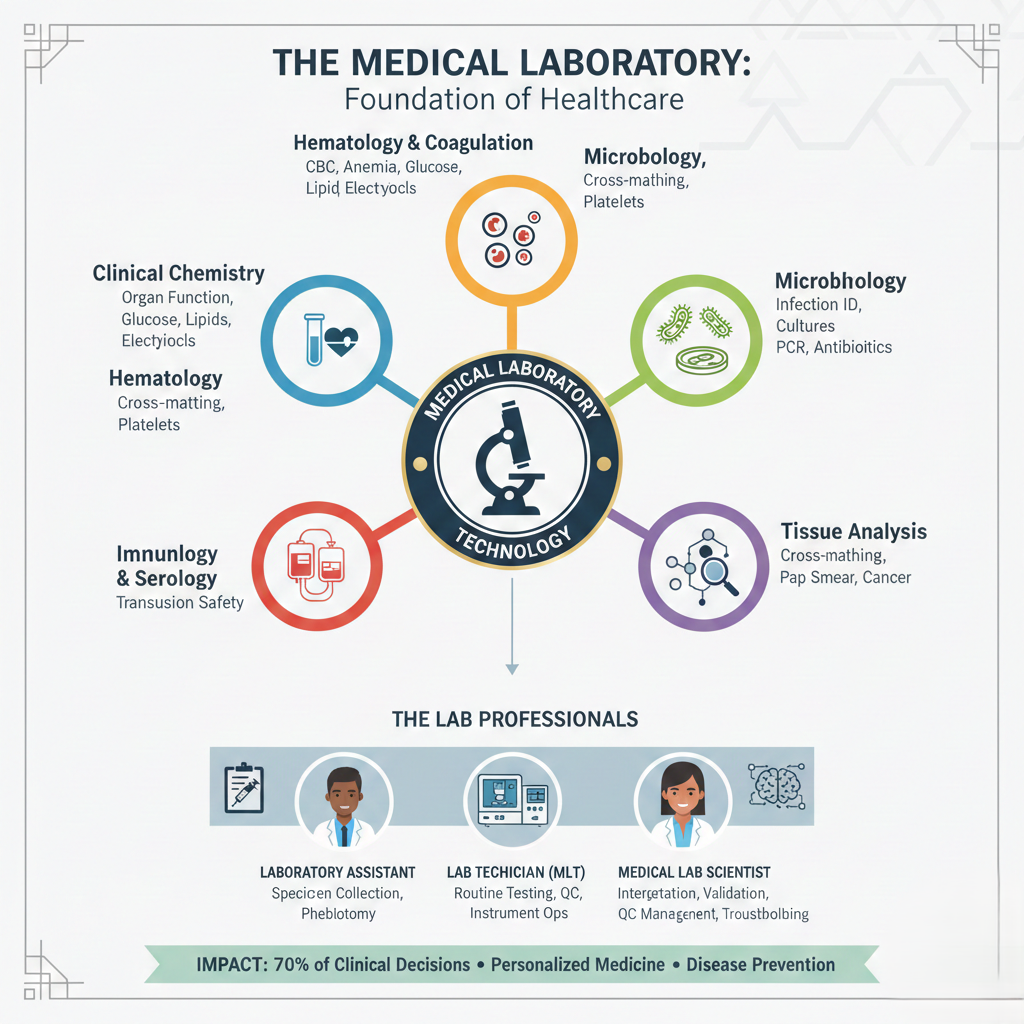
The Medical Lab remains the element influencing 70% of diagnostic and therapeutic decisions within the complex realm of modern healthcare. Beyond the patient’s bedside or the doctor’s office, Medical Laboratory Technology acts as the foundation for diagnosis, therapy, and illness prevention. A tiny sample of blood, urine, or tissue analyzed offers data that transforms a collection of symptoms into a pathway to recovery.
This article will describe the Medical Lab tests. Emphasize the vital roles of the trained experts responsible for this important task: the Medical Lab Scientist (MLS), Lab Technician, and Laboratory Assistant.
The Major Categories of Medical Laboratory Tests and Their Need
A Medical Lab’s scope is extensive, spanning disciplines, each dedicated to uncovering a biological insight. The significance of these analyses ranges from routine wellness assessments, to emergency diagnostic operations, continuous monitoring of chronic illnesses, and forensic examinations.
1. Clinical Chemistry: The Biochemistry of Health
Purpose: Evaluation of organs; specifically the kidneys and liver, their performance and the concentrations of essential chemical components in the body.
Key Tests & Significance:
-
BMP/CMP: These examinations assess levels of electrolytes (sodium, potassium, chloride) and glucose—which help in diagnosing and managing diabetes—along with markers of kidney health such as BUN and creatinine.
-
LFTs (Liver Function Tests): These tests measure the levels of enzymes such as ALT and AST as well as bilirubin in the blood to assess liver function and detect signs of damage or disease.
-
Lipid Panel: This examination measures cholesterol and triglyceride concentrations to determine an individual’s risk of developing cardiovascular disease.
2. Hematology and Coagulation (The Study of Blood)
Indication: Conditions related to blood cells, bone marrow, and blood clotting disorders.
Key Tests & Significance:
-
CBC (Complete Blood Count): A test of the blood that measures and evaluates RBCs, WBCs, and platelets. It is useful in identifying anemia, infections, inflammation, and blood cancers such as leukemia.
-
Coagulation Tests (PT/INR and PTT): These evaluate the process of blood clot formation. These tests are essential for tracking patients on blood-thinning treatments and detecting bleeding disorders.
3. Microbiology (Infection Identification)
Goal: To identify, isolate, and evaluate the susceptibility of pathogens—such as bacteria, viruses, fungi, and parasites—that cause diseases.
Key Tests & Significance:
-
Cultures: To precisely identify the microorganism, a sample (blood, urine, throat swab) is grown in culture.
-
Antibiotic Sensitivity Testing: This is crucial. It aids in identifying the antibiotic that will effectively treat an infection, thus helping to decrease antibiotic resistance.
-
Molecular Diagnostics (PCR): Used for the rapid and highly sensitive detection of pathogens; above all, viruses such as influenza or SARS-CoV-2.
4. Immunohematology (Blood Banking/Transfusion Medicine)
Requirement: To guarantee the safety of blood transfusions, preventing any life-endangering reaction.
Key Tests & Significance:
-
Blood Grouping and Rh Typing: This determines a patient’s ABO and Rh group, which serves as the basis for all transfusions.
-
Blood cross-matching: The critical process of compatibility testing between the blood of a donor and that of a patient to avoid immune rejection.
5. Immunology and Serology (The Immune System)
Need: Diagnosis of autoimmune diseases, detection of the body’s immune response to foreign substances or infections.
Key Tests & Significance:
-
Antibody Tests (Serology): These examinations detect antibodies produced by the immune system in response to infections, like HIV or Hepatitis. Also used after immunization.
-
Autoantibody tests are performed to detect diseases in which the immune system targets the body, such as Lupus (ANA test).
6. Histology and Cytology (Tissue and Cell Analysis)
Specification: Tissue and cellular samples will be analyzed to detect the presence of cancer, tumors, or other cellular abnormalities.
Key Tests & Significance:
-
Biopsy Analysis: The tissue obtained during the operation will be prepared, stained, and examined by a Pathologist to definitively determine the presence of cancer or other health issues. This infographic provides a comprehensive overview of hyperplastic stomach polyps, which are non-cancerous growths that can develop on the lining of the stomach. These growths are composed of an excess of normal stomach tissue, and while they are typically benign, they can sometimes carry a small risk of developing into cancer. This graphic presents the appearance, symptoms, and potential for malignant transformation of these polyps.
-
Pap Smears: Cell samples collected from the cervix are analyzed to identify pre-cancerous and cancerous changes.
The Lab Professionals: Roles in the Medical Laboratory
The Medical Lab functions completely reliant on the knowledge and direction provided by its personnel. Medical Laboratory Technology denotes the discipline encompassing the specialists working together in these capacities to achieve accurate patient results.
The Specialized Knowledge and Roles
1. The Medical Lab Scientist (MLS)
The Medical Lab Scientist (or Medical Technologist) is the technical expert, holding a bachelor’s degree in Medical Laboratory Technology. Their tasks include:
-
Confirmation and Analysis: The MLS will confirm results that appear doubtful or alarming. They carry out specialized follow-up tests and assist physicians in understanding the implications of complex findings.
-
Quality Control (QC): They manage stringent QC processes to ensure every instrument functions correctly, maintaining data precision and the integrity of results.
-
Troubleshooting: If an automated machine fails or produces questionable results, the MLS acts as the on-site expert responsible for diagnosing the problem and applying solutions.
2. The Lab Technician (MLT)
The Lab Technician works in partnership with the MLS, primarily conducting extensive, high-volume tests that support the Medical Lab’s operations. They undergo instruction in Medical Laboratory Technology to manage automated tests and promptly determine when a specimen must be sent to the MLS for advanced review. Additionally, they assist in performing routine tests, like CBCs and Basic Metabolic Panels.
3. The Laboratory Assistant
The pre-analytical phase—denoting the steps before carrying out a test—is handled by the Laboratory Assistant or the Phlebotomist. Frequently, this is the Medical Lab specialist the patient meets.
-
Their main duties include gathering samples (phlebotomy), ensuring the use of the correct tube and attaching the correct label, and properly managing (centrifuging, storing) the specimen prior to transferring it to the Lab Technician or Medical Lab Scientist.
-
The Laboratory Assistant is also responsible for basic Medical Lab maintenance and specimen logging.
The Enduring Significance of Medical Laboratory Technology
Medical Laboratory Technology consistently holds a pivotal position in progressing medicine. Innovations in this field, such as Molecular Diagnostics and Next-Generation Sequencing (genetic testing), signify advances that surpass merely detecting a disease, moving toward predicting an individual’s risk and tailoring therapy according to their unique molecular and genetic profile.
Starting with the Laboratory Assistant obtaining a sample and moving on to the Medical Lab Scientist who confirms the final, complex result, the Medical Lab team functions as an integrated unit dedicated to quality assurance and scientific precision. Their work ensures that healthcare decisions are accurate, data-driven, and ultimately benefit the patient.