
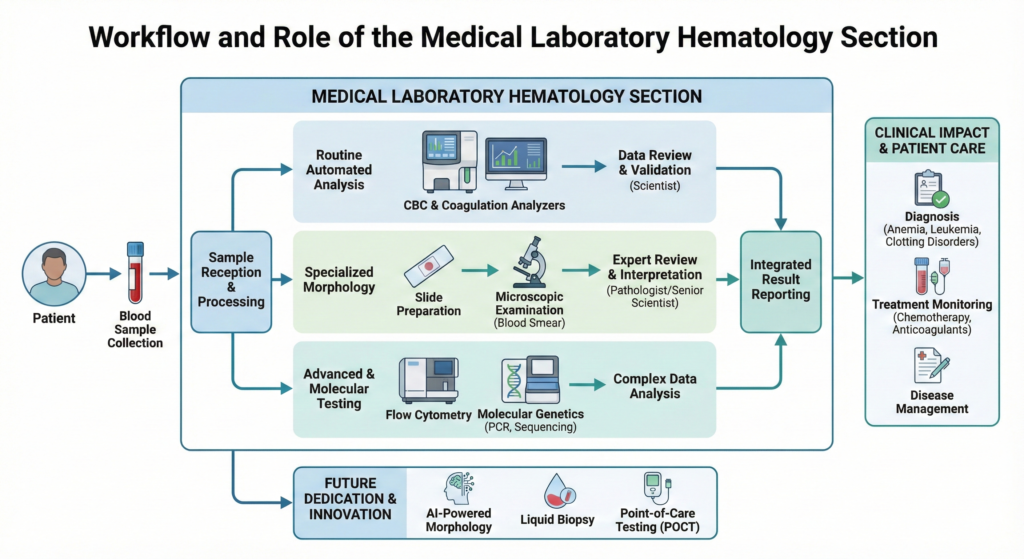
In the complex planet of the current healthcare system, treatment is only as good as the diagnosis made. The Medical Laboratory, the heart of the hospital or the diagnostic center, is where the biological samples are cracked to get the health of the human revealed. Among its different specialized divisions, the Hematology department is the place, which is the most active and, therefore, the most significant.
Blood, the most vital of the body’s life-giving fluids, is checked here for various kinds of diseases, be it just an infection or a cancer of the most intricate kind. This paper goes down to the very bottom of the department of Hematology to find out, first of all, what tests are there, and next, what role does it have in the care of patients and, finally, what will be its future and how it fits in the concept of Laboratory medicine.
Introduction to the Hematology Section
Hematology is the branch of medical science that deals with the understanding of the causes, predictions, treatments, and prevention of diseases related to blood. Being the main transport system of oxygen, nutrients, and waste products, blood reaches every organ and tissue. Therefore, any alteration in blood composition is very likely to be a mirror of some systemic health problem. The changes are then analyzed by Laboratory medicine specialists who thus provide clinicians with the data and decision-making becomes facilitated.
The Pivotal Role of the Hematology Section
The most important function of the Hematology department is to be used as a diagnostic detective tool. Usually, when a patient comes with vague symptoms such as weakness, fever, or bruising without a cause, the Hematology report is what first points towards the solution of the riddle.
Screening and Diagnosis:
The most instrumental role performed by the screening method is that of the general health. A mere Complete Blood Count (CBC) may reveal anemia, infection, or diseases of the immune system. In the case of such serious conditions as leukemia or lymphoma, specialized Hematology tests are the ultimate source of diagnosis.
Monitoring Disease Progression:
In case of chronic diseases, the patients are submitted to regular Hematology testing for the progression of the diseases to be closely followed. For instance, immune system functionality in HIV treatment is checked through white blood cell counts.
Therapeutic Monitoring:
Many treatments are of the nature to necessitate careful presence. Patients on chemotherapy are prone to bone marrow depression which in turn causes a decrease in blood cells. The Hematology lab is the one that gives the data for changing or dropping the dosage to ensure the patient’s safety. Likewise, coagulation studies (blood tests that assess clotting) are necessary for patients taking anticoagulant drugs, so as to avoid bleeding or clot formation.
Pre-surgical Assessment:
Before doing any major surgery, Laboratory medicine protocols require the assessment of a patient’s clotting ability and oxygen-carrying capacity. The Hematology section is the one that announces whether the patient is good enough for the operation and assists the surgical team in getting ready for blood loss, if any.
Key Tests in the Hematology Laboratory
The modern Hematology laboratory can be compared to an orchestra whose repertoire is extensive. The tests performed vary from high-volume automated screens to highly specialized manual investigations.
Summary of Key Tests
| Test Category | Key Components/Focus | Primary Purpose in Laboratory Medicine |
| Complete Blood Count (CBC) | RBCs, WBCs, Platelets, Hb, Hct | Screening for anemia, infection, and leukemia. |
| Coagulation Profile | PT/INR, aPTT, Fibrinogen, D-Dimer | Assessing clotting ability and monitoring blood thinners. |
| Blood Smear | Cell morphology (shape, size) | Identifying malaria, sickle cells, or blast cells. |
| ESR | Sedimentation rate of RBCs | Non-specific marker for inflammation. |
| Flow Cytometry | Cell surface markers | Immunophenotyping for leukemia/lymphoma classification. |
| Bone Marrow | Marrow structure and cellularity | Diagnosing marrow failure and cancers. |
1. The Complete Blood Count (CBC)
The CBC is the main work of the Hematology department and is probably the most frequent test performing a quick look at cell health by quantifying:
-
Red Blood Cells (RBCs): The molecules of hemoglobin that contain iron. When the levels are low one has anemia, while high amounts (polycythemia) may also be signs of oxygen deprivation or bone marrow disorders.
-
White Blood Cells (WBCs): The immune system’s defenders. Here, abnormalities can be the reason for blood coming out excessively or the possibility of thrombosis.
-
Hemoglobin and Hematocrit: These indicators show oxygen-carrying capacity and volume of the blood.
2. Coagulation Profile (Hemostasis)
Testing for hemostasis is a very important and quite an independent sub-unit in Hematology. The main aim is to find out how the body can produce the clot and also stop bleeding. These include:
-
Prothrombin Time (PT) / INR: Mainly helps to control patients using Warfarin (an anticoagulant) and evaluate the extrinsic pathway of coagulation.
-
Activated Partial Thromboplastin Time (APTT): Establishes Heparin therapy management and evaluates the intrinsic pathway.
-
Fibrinogen and D-Dimer: D-Dimer, in particular, is very helpful in Laboratory medicine when one needs to exclude deep vein thrombosis (DVT) and pulmonary embolism (PE).
3. Peripheral Blood Smear Examination
Although most of the work is done by devices, looking at a blood smear under a microscope by hand is still considered the highest standard in Hematology. In situations when automated analyzers have detected abnormal cells, a laboratory scientist skilled in this field will look at a stained slide and identify:
-
Malaria parasites: Even nowadays, direct visualization is the main way of diagnosis in a great number of places.
-
Abnormal cell shapes: It is here that the scientist sees sickle cells (in Sickle Cell Anemia) or broken cells (schistocytes).
-
Blast cells: These are the immature cells that can signal acute leukemia.
4. Erythrocyte Sedimentation Rate (ESR)
Being an old test, ESR is still commonly used in Laboratory medicine as a marker that is non-specific for inflammation. The test measures how fast red blood cells settle in a tube. A high rate corresponds to inflammation, thus helping in the diagnosis of temporal arteritis or rheumatoid arthritis.
5. Flow Cytometry
The advanced Hematology uses a technology that is very complex and it is called flow cytometry. It has the cells suspended in a fluid, and one by one the cells are approached by a detector that is electronic. The detection is based on cell surface markers (immunophenotyping), the markers being necessary for identifying different leukemia and lymphoma.
6. Bone Marrow Aspiration and Biopsy
A look at the “factory” where blood is produced becomes the only option when peripheral blood tests cannot provide an answer. Even though a doctor is the one who does the procedure, the Hematology laboratory is the one that receives, processes, and analyzes the samples. The pathologists look at the marrow structure and measure dormitory to diagnose marrow failure syndromes, cancers, and storage diseases.
Instrumentation and Technology
The present-day Hematology laboratory is a brilliant creative achievement. Most of the work is done nowadays by sophisticated automated analyzers which have almost completely taken over the laborious manual task through a hemocytometer.
-
Automated Hematology Analyzers: These devices incorporate techniques such as electrical impedance and flow cytometry to measure and identify cells of various sizes in a matter of seconds with a high degree of accuracy. They are the main drivers of high throughput and efficiency in Laboratory medicine.
-
Digital Morphology Systems: This technology captures the images of blood smears with cameras and uses AI algorithms to recognize and pre-classify cells. Later, a human expert confirms the results on a screen, thus saving the workflow and allowing remote consultations.
The Future Dedication of Hematology
Hematology is a very vibrant area and is not going backward in time but rather it is undergoing profound changes due to technology and molecular biology. Next to this, the future commitment of this department is to be more precise, personalized, and integrated.
Molecular Hematology and Genetics
The future of Laboratory medicine is predetermined by genetic factors. Hematology goes more and more towards molecular diagnostics. Besides, morphology of cells, labs are now focusing on the mutations in DNA which are the cause of diseases.
Artificial Intelligence and Machine Learning
One of the major changes in the Hematology unit will be brought about by AI. Machine learning programs get trained with millions of images of blood cells in order to find minute abnormalities that a human might overlook. Not long from now, AI may be used as a preliminary diagnostic tool which will be responsible for identifying difficult cases of rare diseases that later need human examination.
Point-of-Care Testing (POCT)
More and more attention is paid to the need to bring Hematology testing to the patient’s proximity. Portable instruments that can perform a CBC or provide INR levels at the bedside or in a doctor’s office are increasingly popular.
Liquid Biopsy
Although it has been mainly associated with solid tumors, the idea of liquid biopsy is becoming more and more acceptable in Hematology. This method detects the tumor DNA that circulates in the blood of relapse leukemia patients and thus enables disease monitoring without the need for invasive bone marrow biopsies. This is a huge step towards enhancing patient comfort as well as monitoring effectiveness.
The Role of the Laboratory Professional
Despite the advent of all this technology, the role of man remains indispensable. Medical Laboratory Scientists (MLSs) and technicians are the people who work in the background in the Hematology section and they should be highly acknowledged. In Laboratory medicine, a result is dependent on the quality assurance that stands behind it.
Challenges and Ethical Considerations
Hematology, as it progresses, has to deal with various issues. The very expensive cost of high-end molecular testing could limit the availability of such tests to certain groups. Additionally, the use of genetic data raises concern about individuals’ privacy. Laboratory medicine must handle these ethical issues with great care and ensure that all patients are treated fairly and receive equal benefits from advances. Besides that, more and more automation calls for changes in workforce training.
Conclusion
The Hematology section represents a vibrant and imperative Laboratory medicine‘s pillar. In this new era, the diagnoses will be made faster, their accuracy will be higher, and the understanding will be more profound than ever. The ultimate aim, regardless of whether it is through the view of a microscope or the computation of a computer, is to decipher the story that the blood tells.