
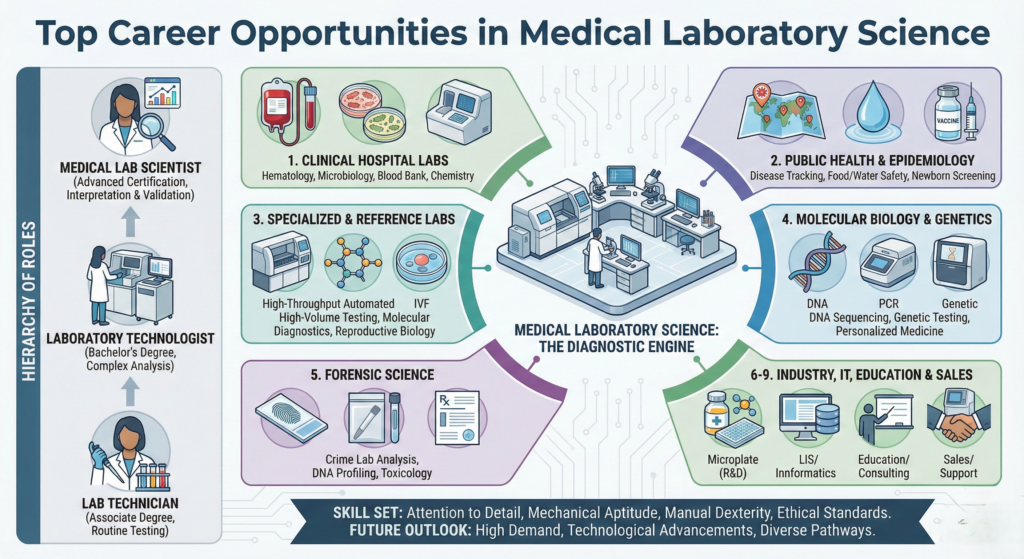
We often visualize doctors when we think of healthcare and nurses when we think of care providers. But is not the question: Without Laboratory medicine, how can doctors and nurses be sure their diagnostic decisions lead to the cure? That is why the Medical Lab Technology field is considered one of the most indispensable, trouble-resisting, and varying sectors in the healthcare industry. If you are only starting your career as a Lab Technician, or you plan to reach a top position as a Medical Lab Scientist, there are numerous career paths waiting for you, and they are all very exciting and fruitful.
Comprehending the Hierarchy of MLS:
Technicians vs. Technologists vs. Scientists
It is a must and very helpful to know the difference of each of these roles first before going deeper into the career paths. These terms are usually referred to in the same context, but they mean different things regarding education and practice.
Lab Technician
is a person who works at the base level of the laboratory. Usually, an associate degree or a certificate is the typical education background of a Lab Technician. He or she is in charge of the routine testing and the very important pre-analytical phase. The technicians do the sample processing, they also check if the instruments are working properly, and they do less complicated tests. Their job is the basis of laboratory work, at which they make sure the preparations of samples for complicated tests are done perfectly.
Laboratory Technologist
is the one who has moved up the educational and professional ladder. This expert commonly holds a bachelor’s degree in Medical Lab Technology or any related natural science. A Laboratory Technologist executes complicated biological, chemical, hematological, immunologic, microscopic, and bacteriological tests. They learn to examine the outcomes for precision and often manage and train technicians.
Medical Lab Scientist
In some places, the terms Laboratory Technologist and Medical Lab Scientist are synonymous. Although, a medical laboratory scientist usually means a higher level of certification (like ASCP in the US) and a wider scope of theoretical knowledge. A Medical Lab Scientist is like a detective in diagnostics who finds ways to explain abnormal results, solves the problems if complex instruments are causing errors, and does the final confirmation of new testing methods. The three workers—Lab Technician, Laboratory Technologist, and Medical Lab Scientist—are the gears which hold together the machine of Laboratory medicine without fail.
| Role | Typical Education | Primary Responsibilities | Scope |
| Lab Technician | Associate Degree / Certificate | Routine testing, sample processing, instrument checks, pre-analytical preparation. | Foundational support and routine analysis. |
| Laboratory Technologist | Bachelor’s Degree | Complex testing (biological, chemical, microscopic), analyzing outcomes, supervising technicians. | Intermediate to advanced analysis and supervision. |
| Medical Lab Scientist | Bachelor’s Degree + Advanced Certification | High-complexity diagnostics, troubleshooting errors, validating new methods, interpreting abnormal results. | Advanced diagnostics, problem-solving, and method validation. |
1. Clinical Hospital Laboratories: The Heart of Healthcare
The major connecting point between Laboratory Professionals and hospitals is the workplace. A hospital, in its entirety, is not a playground of monotonous jobs; on the contrary, the chances here are split into various vibrant departments.
Hematology and Coagulation
A Medical Lab Scientist, in this department, studies blood cells to detect anemias, leukemias, and infections. They also take care of the blood clotting process, which is very important for patients who are to undergo a surgical operation or those who are on blood thinning medication.
Microbiology and Virology
The role of Laboratory medicine in microbiology has been very important during the last few years because of the pandemic, but the work done in this field was always essential. At this place, a Laboratory Technologist grows bacteria so that they can figure out the pathogens causing the infection and also decides which antibiotics will be able to kill the bacteria that have been taken.
Blood Banking (Immunohematology)
This is the most risky part of the lab if one asks the question: Where is the blood bank? They figure out blood types and test for the presence of antibodies. A single error here might lead to death, that is why the accuracy of Medical Lab Scientist is very essential.
Clinical Chemistry
This is what most people would say is the busiest and most automated section of the lab. The one who is just a Lab Technician may be the one who will load the machines that are going to measure blood sugar, electrolytes, enzymes, and hormones.
2. Public Health and Epidemiology
Are you more interested in Population health rather than individual patient care? If so, then public health laboratories are the right place for you to grow your career. In these places, the Laboratory Professionals track disease outbreaks, keep the quality of food and water under surveillance, and check for biological threats.
Public health laboratories at both state and federal levels count a lot on the proficiency of a Medical Lab Scientist to be sure of the cases of rare diseases when hospital labs cannot handle them. For instance, during a measles outbreak or a flu epidemic, it is the experts in Laboratory medicine who do the public health work and prepare the data afterward it can be used for the government policy and strategy of containment.
Thirdly, a Lab Technician may be working in a public health institution, where he/she may be involved in the newborn screening program, thus, doing the process of thousands of samples to find out genetic disorders at a very early age. This is one of the most direct ways that Medical Lab Technology can have a positive influence on community health.
3. Reference and Specialized Diagnostics Laboratories
A Laboratory Technologist can decide to work on one specific area that could either be molecular diagnostics or toxicology to name a few in such a lab. Since these laboratories accept samples from all over the country, there is a high demand for Laboratory Professionals who are skilled at handling high-throughput automation because the volume is towering.
There are also specialized laboratories for certain areas such as reproductive biology (IVF labs). A specialized Medical Lab Scientist (usually an embryologist) collaborates with gametes and embryos, which is highly specialized, and also one of the most highly paid niches within Laboratory medicine.
4. Molecular Biology and Genetics
The fate of Laboratory medicine is rooted in our DNA. The most rapidly expanding sector in the field is molecular diagnostics. This involves a thorough knowledge of Medical Lab Technology and bioinformatics. As personalized medicine becomes more and more common, the need for Laboratory Professionals who have molecular skills will continue to be higher than the number of available professionals.
5. Forensic Science
If you are a fan of true crime and investigative stories, then you will find a background in Medical Lab Technology to be a perfect stepping stone into the field of forensics. In most cases, forensic labs are the ones that deal with the biological evidence obtained from crime scenes.
Though the work is hardly as sensational as that shown in TV series, it is, however, a scientifically rigorous one. A Laboratory Technologist in forensic might be engaged in any of the following: DNA profiling, trace evidence analysis, or toxicology (identifying drugs or poisons in a body). Due to the strict chain of custody and legal consequences of this work, Laboratory Professionals need to be of the highest integrity and highly skilled in documentation.
6. R&D
Biotech and pharma companies are actively looking for skilled people from the Laboratory medicine field. Before a drug or a vaccine could be marketed, it has to be tested in clinical trials. These trials require continuous monitoring of patient health data, which is the output of Laboratory Professionals.
In R&D a Medical Lab Scientist may be involved in creating new diagnostic test kits. They ensure that a new reagent or analyzer is functioning correctly. This position often acts as a bridge between pure science and product development, thus, a Laboratory Technologist can be a part of medical breakthroughs that later will be accessible worldwide.
7. Laboratory Information Systems (LIS) and Informatics
With labs getting more automated, the confluence of IT and Medical Lab Technology has resulted in creation of a highly regarded career niche. Laboratory Information Systems (LIS) Analysts are mostly ex-bench tech workers who have made a career change to the IT field.
8. Education and Consulting
Due to the older workforce, there is an urgent and increasing demand for educators to train the coming generation of Laboratory Professionals. Veteran practitioners very often switch to the academic world, teaching in Medical Lab Technology programs at community colleges or universities.
9. Sales, Marketing, and Technical Support
Who is responsible for selling complicated analyzers and microscopes to hospitals? In most cases, it is a person who knows how to operate such equipment. Biomedical companies are on the lookout for a Medical Lab Scientist or Laboratory Technologist to fill sales and technical support positions.
The Skill Set of Successful Laboratory Professionals
Success in this field requires a certain combination of hard and soft skills regardless of the exact path chosen.
Firstly, being very attentive to details is a must of the non-negotiables. For instance, if you are a Lab Technician labeling a tube or a Medical Lab Scientist issuing a critical result, a tiny mistake can lead to serious consequences.
In addition to that, a person with mechanical aptitude will have an advantage in the future. The field of modern Laboratory medicine depends on sophisticated robotics. Laboratory Professionals are expected to be able to solve both hardware and software problems in case of machine failure.
Besides, there is a need for good manual skills as well. Even if there is automation in place, a Laboratory Technologist should still be capable of manually pipetting small amounts, streaking agar plates, and making blood smears accurately.
Last but not least, ethical standards of the highest level are the core of the most important ones. Often laboratory workers do their job without direct supervision. Honest enough to admit their mistake and take steps to remedy it, thus, they have what it takes to be further distinguished: from good to great Lab Technicians.
Education and Certification Pathways
One can get into the field of Medical Lab Technology only through formal education and most of the time certification is needed as well.
Commonly an Associate of Applied Science degree is necessary to become a Lab Technician. Such programs put the main focus on the technical parts of testing and specimen collection.
A bachelor’s degree is the usual requirement to become a Laboratory Technologist or a Medical Lab Scientist. Such a degree involves rigorous studies in organic chemistry, biology, anatomy, and includes hospital and microbiology lab rotations as well.
The Future of the Field
The prognosis for Laboratory medicine is very promising. The Bureau of Labor Statistics is always forecasting the expansion of this sector to be quicker than the average one. With the population getting older, the demand for diagnostic testing will surely go up. Besides that, the retirement of the “Baby Boomer” generation of Laboratory Professionals has resulted in a shortage of staff that in turn leads to higher wages and sign-on bonuses.
Conclusion
The Medical Lab Technology profession has a unique mixture of science, technology, and service. It is a job where you get to solve riddles every day and at the same time have the satisfaction that the solutions you discovered are making people’s lives better. From the Lab Technician who ensures that the sample is viable, to the Laboratory Technologist who operates the state-of-the-art analyzers, to the Medical Lab Scientist who interprets the complex data, none of the roles is unimportant.